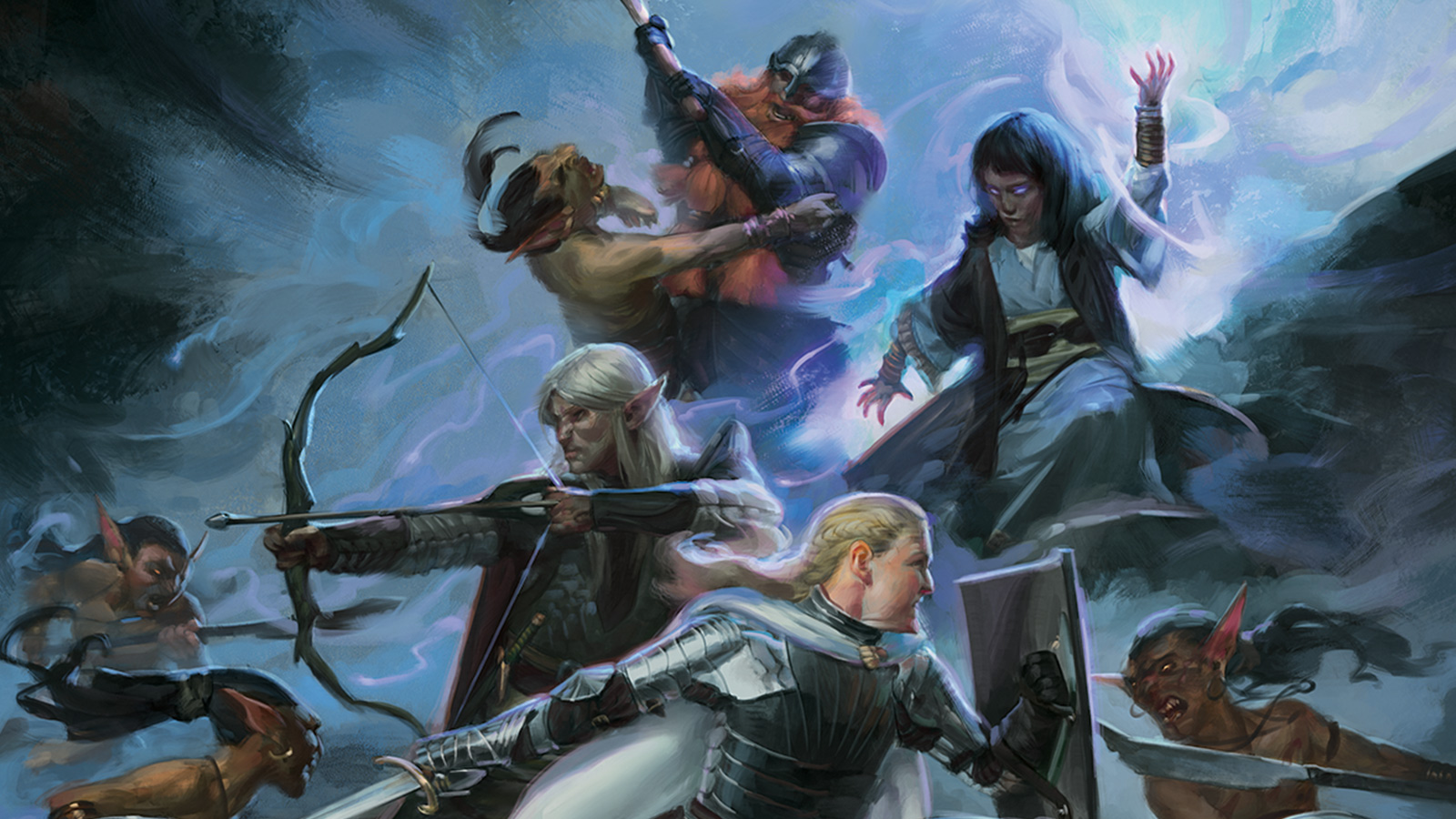
Dungeons and Dragons is more than just a world to explore in Baldur’s Gate 3 or something to be intrigued by after watching Stranger Things. Instead, it’s a vast and sprawling game filled to the brim with rich lore and endless tales that’s been around since the 70s and has arguably never been more popular than it is today.
But with this newfound surge in popularity comes a rise in new players wanting to learn how to play the game, previously reserved for only the darkest and dankest of basements.
Thankfully, getting into Dungeons and Dragons for the first time isn’t half as daunting or intimidating as it might seem.
At its core, Dungeons and Dragons is a collaborative storytelling and boardgame experience set within a fantasy world filled with dungeons, dragons, monsters and magic, where various dice rolls help to decide how the game and story progress.

Playing Dungeons and Dragons is a simple, three-step process:
First, the Dungeon Master will describe the scenario. Players will then decide what they want to do, and finally, the Dungeon Master will ask players to roll their dice to see if they succeed or fail.
While playing, players will embark on epic quests where imagination is truly the limit, meaning the journey is never linear. Instead, players will write the story as they play and choose how their character acts and reacts within it.
To structure the game, one player will act as the Dungeon Master, who can be thought of as the game’s narrator and whose responsibility is to flesh out the core story.
The story that the Dungeon Master tells could be something that they wrote themselves, a pre-written adventure or even something entirely improvised on the spot.
Whether you’re a newcomer or a seasoned veteran, the basics always remain the same, and the first thing you’ll want to do is gather up a party.
While almost any player count works, the most common party will consist of four players and one Dungeon Master.
Aside from guiding players through the adventure, the Dungeon Master will also ensure that everyone follows the core rules and decides on the consequences of players’ actions.
While there are plenty of rules to learn in the game, the beauty is that players can start playing almost immediately and then incorporate more rules as they become more comfortable.
A lot of the logic used for the game also mimics what we deal with in the real world.
Falling off a cliff will likely end in your demise, or at least with some nasty wounds. Trying to shoot someone hiding behind a wall with an arrow probably won’t work, and climbing a tree will surely give you a better vantage point.

Combat in the game is always dungeon master versus player, with the Dungeon Master controlling monsters the same way players control their characters by using dice rolls to determine whether attacks and spells hit and how much damage they do.
Because Dungeons and Dragons is a game that’s been around for multiple decades, it’s easy to feel lost when figuring out what exactly you need to get playing.
However, there isn’t much that you genuinely need to get started on your way. Players will need character sheets, which come with the Starter Set or can be printed for free online, a trusty pencil, a notebook, some delightfully shaped polyhedral dice and access to the game’s basic rules.
Everything you need to start can be found within the official Dungeons and Dragons Starter Set, including a pre-written adventure.
Of course, if you want to take your games more seriously, there are some additional items you can pick up, like a nice set of dice for each player, a Dungeon Master screen and the three core books.
The Player’s Handbook covers everything players need to know, from rules to character creation, casting spells and the intricacies of fighting monsters.
The Dungeon Master’s Guide is a book specifically for Dungeon Masters. It focuses on how to run adventures properly, mediate players, and create your own stories.
The final book you should pick up is the Monster Manual, a tome filled with creatures, big and small, to add to your adventures.
By picking up those three books, a starter kit and some extra dice, you’re ready to go forth and adventure through the dark, dangerous and wondrous worlds of Dungeons and Dragons – and you don’t even need access to a basement to do it.

Dicey tales of D&D
While Dungeons & Dragons covers vast universes of lore and story, it is also synonymous
with a particular item: the D20 dice. This 20-sided polyhedral dice is iconic to the game, combat scenarios, and even the whims of fate.
The power of probability:
The D20 allows for a 5% chance for each possible roll, making it a fair and unpredictable determinant for success or failure in the game.
More than just the D20:
D&D utilizes a set of seven different dice, collectively known as the ‘Polyhedral Dice Set’. This includes the D4, D6, D8, D10, D12, D20, and a special percentage dice (D100 or D%). Each has its own specific use, from determining weapon damage to rolling percentage chances.
Custom dice collections:
Many players take pride in their dice collections, with some dice made from materials like gemstones, metals, and even bone. It’s not uncommon for players to have a ‘lucky’ dice that they swear rolls better than others!
Dice superstitions:
Just like in any game of chance, players have developed numerous superstitions around their dice. Some never let others touch their dice, believing it can “drain” their luck. Others might “punish” dice that consistently roll low by placing them in “dice jail”. In essence, while the tales and adventures of D&D are vast, the clatter of the dice on the table is a sound that rings true for every player, symbolising the unpredictable nature of the game and the stories yet to unfold.
First Published in NAG Magazine The Annual 2023
Get the latest NAG Magazine at shop.nag.co.za