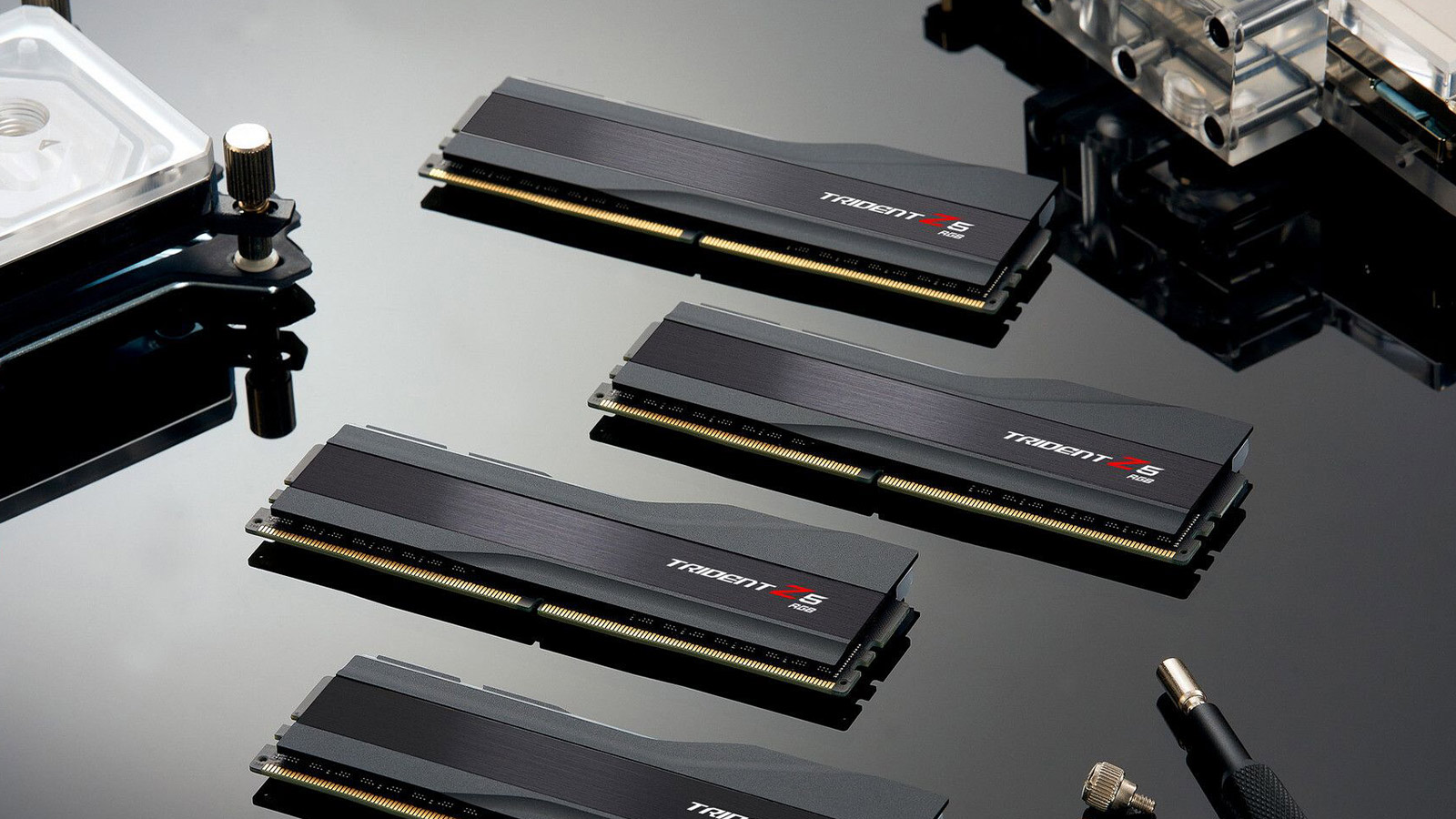
Desktop computing has had DDR5 for two years and almost three generations. The first desktop platform to support DDR5 was the Z690, and it was launched in October 2021. Back then, DDR5 at 6,400MT/s (3,200MHz) was a pipe dream, but here we are in late 2023 with retail kits capable of DDR5 8200 (4,100MHz), incredible! Even more impressive is that we can now buy DDR5 8000 memory for less than what DDR5 5600 was sold at just a year ago.
One such kit is the G. SKILL Trident Z5 RGB 48GB CL32. Unlike the typical 32GB set, this memory features 24GB sticks for a combined total of 48GB. It is also worth noting that if you enjoy tinkering, the extra cost of these 24GB sticks is worthwhile as they overclock better than the 16GB sticks.
Before we get into the performance and overclocking, it’s important to note that the memory offers fantastic performance straight out of the box. Just enable X.M.P on your motherboard, and you should get an instant boost in gaming performance (compared to reference DDR5 5200 and 5600 memory). The TridentZ5 RGB has excellent performance and can handle demanding applications with ease due to low timings at CL32-39-39-89.
Memory improves with more time devoted to it, and this kit is the quintessential example of this time investment. After spending a little over half an hour, I managed a healthy DDR5 8000 setting at the factory voltage of 1.35V. The timings were relaxed, but only to match those of the G. SKILL DDR5 8000 kits, rated at CL40-48-48-128 1.35V.
So, for R3,700 or thereabout – we don’t have local pricing yet – you can bag yourself a free upgrade to a kit that would otherwise cost you close to R6,000.
While I cheer for such a frequency, an exceptional motherboard is required, and those are two DIMM or, at the high-end, four DIMM motherboards. Considering this, the most important results for this review are in the DDR5 7200 and DDR5 6400 ranges. The DDR5 8000 results will only be relevant in an upcoming editorial piece.

Even older Z690 motherboards, which aren’t as reliable beyond DDR5 7000, can benefit from this memory. This kit is still worth consideration on these motherboards as it can operate at 3,500MHz (DDR5 7000) CL34-40-40-84. It does this at a paltry 1.25V, which is lower than the factory 1.35V spec. The memory also allows one to add raw frequency and improve absolute latency (6400 CL32 has a higher latency than 7000 CL34) while reducing operating voltage. It is seldom that overclocking decreases temperature and power consumption while increasing performance.
The most impressive thing about the G. SKILL Trident Z5 RGB 48GB CL32 memory is its ability to compensate via lower latencies where higher speeds are not an option.
That said, it’s important to realise that high-performance DRAM will not improve your gaming experience if the bottleneck is your GPU. For instance, if you’re using a GeForce RTX 4060 Ti at 1080P with a Core i5 12600K or equivalent, there’s likely no difference between DDR5 6400 and DDR5 7000. That said, overclocking the memory can improve the frame rates if you have a powerful graphics card but a weak CPU.


Performance aside, the memory has full RGB lighting, compatible with motherboards ranging from ASRock, ASUS, GIGABYTE and MSI. The lighting appears brighter compared to the DDR4 sticks, but I could be mistaken, as the diffuser is different. Regardless, the memory looks just as well as it performs.
This memory has secured its place on my test bench, operating at a respectable DDR5 8,200. By any measure, it’s the fastest memory I’ve tested to date. The memory to displace it will need to have exceptional overclocking headroom, timings or a combination. The asking price is justified for the performance, assuming it stays well below R4,000. Does it run warmer than I’d like? Yes, but I’ve not measured the direct temperature of the DRAM ICs as I rely on a software reading of the PMIC instead. Testing loads such as the Karhu Ram Test, which are not representative of how I use my computer, result in peak temperature readings of 53C — a temperature I recorded after one hour of load. DRAM won’t get that hot during regular gaming.
Overall, I’m impressed by the G. SKILL Trident Z5 RGB 48GB CL32 memory kit; it stands unchallenged by any DDR5 kit I’ve tested to date. This exact SKU is not yet available in South Africa but should arrive soon; just pester Wootware, and tell them we sent you. Meanwhile, you may purchase the CL36 variant, which seems to use the same Hynix ICs except for being a lower bin. The memory should perform all this set’s feats, timing-wise.
This memory is precisely what we all want: high performance at a reasonable price. There’s no obvious reason to me why you’d not consider this Trident Z5 DDR5 set.