The indie game industry’s popularity is a double-edged sword that I love swinging around. Yes, there are so many games that people, not devs, are releasing to make a quick buck, and the games are complete dog-uh-poo, but if you know how to sift through it like an expert tracker, you will find the good stuff.
Quite often, I will find myself scrolling through social media and, because of my line of work, will come across a little sneak peek of a game that someone is working on. If it looks good, I’ll add it to the list.
One of these “good-looking” games was Absinthia.
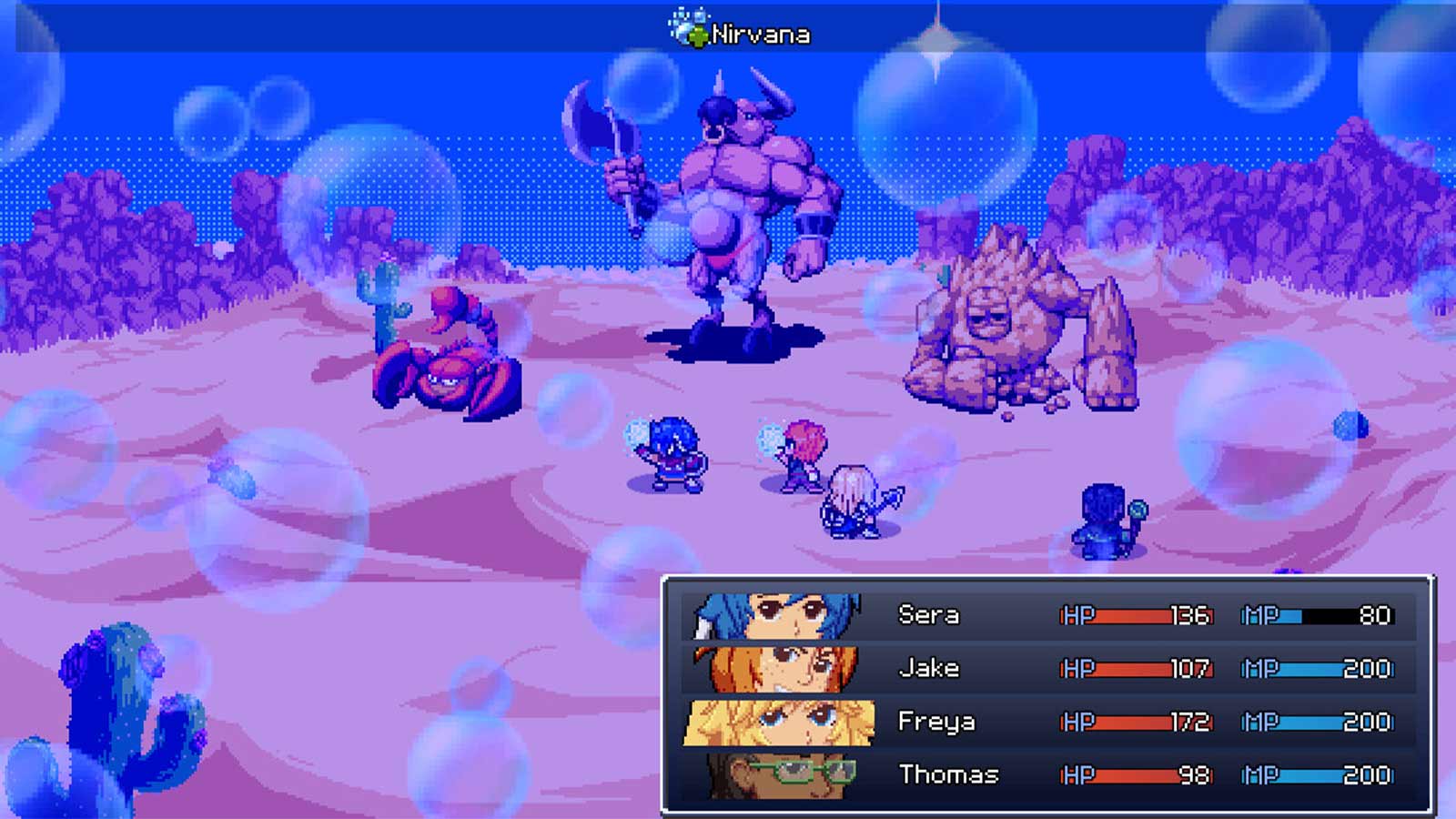
Good-looking is entirely subjective. To me, games that remind me of my childhood experience, sitting all cosied up with a Gameboy in hand, are good-looking – not breathtaking, but they have an appeal that calls to me. Absinthia is one of these games. It’s a pixel-art, 2D-top-down, turn-based, RPG game, that ticks so many of my boxes.

Now, I don’t know if it’s just me or because there’s a risk of this being one of those poo games I spoke about earlier, but starting up a game for the first time makes me a little nervous. Almost like it’s a first date or something. In typical “retro” game fashion, though, Absinithia booted up in windowed mode. At this point, I knew it would hold up to the games of old. You don’t get a pixel-perfect game in full screen; it just doesn’t work that way.
It is here that I recommend that you make sure you have a controller connected. It’s not a requirement or anything, but games like these were just made for a controller.
The story begins just as any other would; you and a rag-tag bunch of friends have been chosen to protect your small and peaceful village from the evil that approaches. In this case, you’re Sera, a young warrior who has been trained by one of the best in the biz. Your friends, Thomas and Jake, have been trained alongside you.
At first glance, there isn’t much of an extraordinary story here, but as the game develops, the story evolves and grows. Yes, it still isn’t anything that will blow you away, but it has its moments and is very reminiscent of the type of storytelling from the early 2000s. While the story isn’t bad, I feel like it’s one of Absinithia’s weakest points. It just didn’t punch like I was hoping it would.

If you’re one for searching every corner of the map to find secret treasure, then you’re in luck. The game devs have gone through the effort of adding hidden elements that you could easily overlook, but with my keen senses developed for these things, I was definitely not leaving a single stone unturned. Again, Absinithia just kept giving off those Gameboy vibes.
Battles are turn-based, which I am thrilled with; they don’t offer up much flair or flamboyance initially, but as the game goes on, you learn quite a few interesting techniques and skills that can make for an exciting battle. Your health and mana are also persistent between battles. Sometimes a game gets this way off balance, and I find myself saving every 5 minutes and re-loading if I make one wrong move in a battle. This wasn’t the case here. I was able to manage my health and mana, but it still made me make sure that I managed it.
One of my favourite parts about the game was the puzzles. I’d often find myself slogging through a few fights and doing a bit of exploring, to find myself getting a little bored, to be quite honest, when suddenly, a puzzle room! It probably stems from my parents always telling me to finish my food before I can leave the table, but I just can’t put a game down if you stick me in a good puzzle room. I’ve just got to get it done. Absinthia does puzzle rooms well, just like in the good ol’ days.

You may be picking up a bit of a pattern here, and maybe that pattern looks a little like a doily, but hey, we all know that deep down inside, we love visiting grannies’ place.
While Absinthia may not be your favourite chair to sit in, it’s still a comfortable space to spend your time, and besides, it’s only 15 hours or so of gameplay.