There’s a lot to be said about all the elements that need to come together to make gaming the magical experience it is. Most importantly, comfort is a must whether you’re a PC, a console, or even a mobile gamer.
Comfort can come in many ways. It can be about where you’re sitting, it can be about finding a headset that fits comfortably over your glasses, and it’s definitely about keeping your hands happy.
For PC gamers, that comes down to choosing a mouse and keyboard that feel right for you; for mobile gamers, the experience can be improved by finding the perfect case to maximise comfort; for console gamers, it’s all about that controller.
Xbox was the first console company to realise how vital comfort truly is when they released the Elite controller in 2015. In contrast, Sony has never released their premium counterpart, until now.
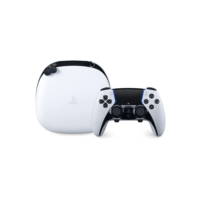
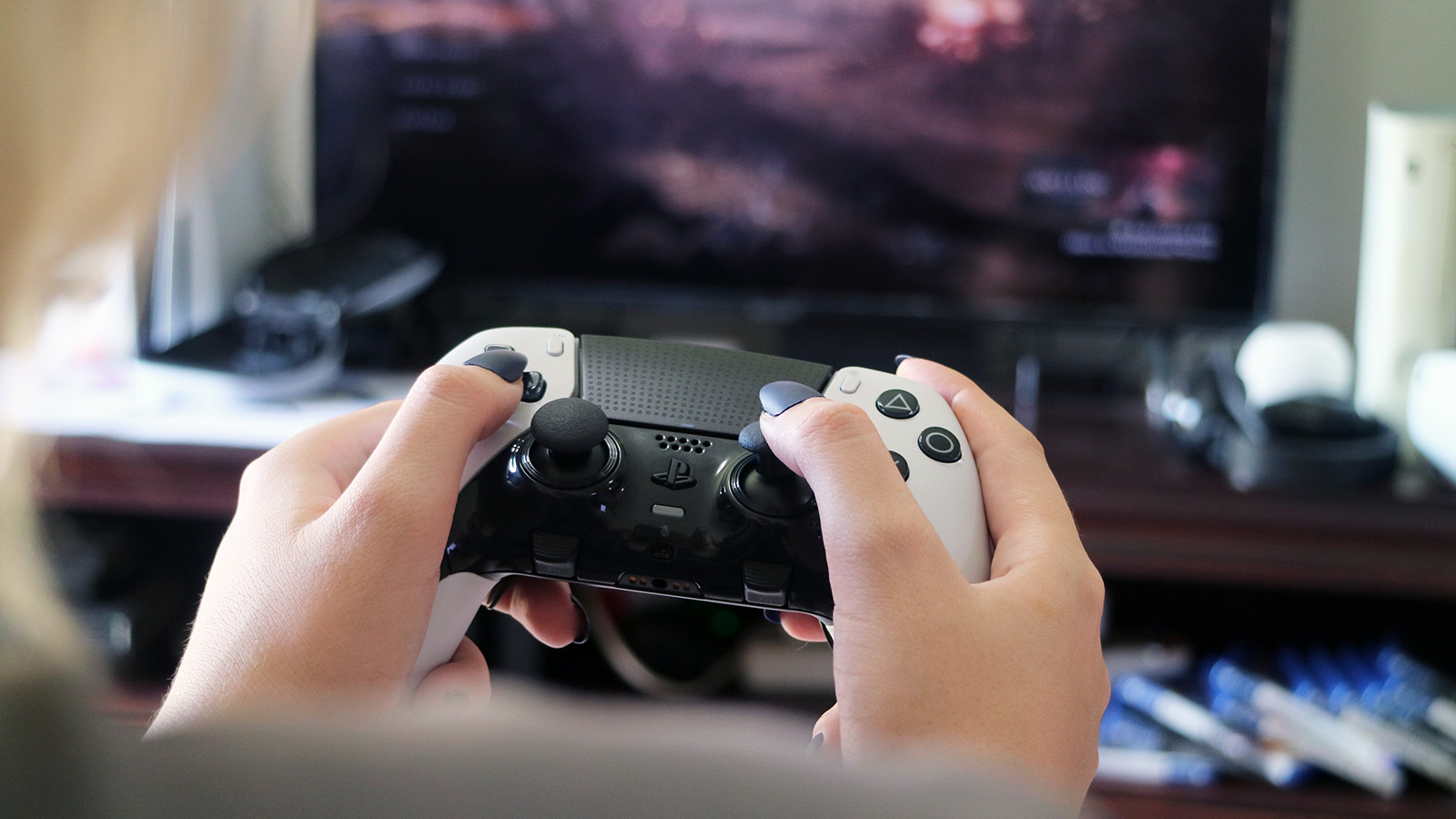
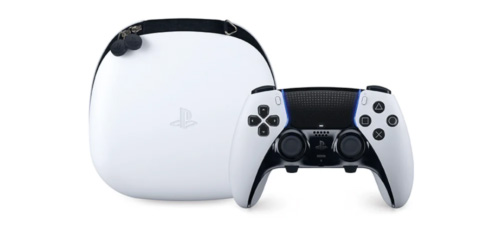
The DualSense Edge is Sony’s new premium controller explicitly designed for the PlayStation 5. Aesthetically it doesn’t stray too far from the default controllers. At first glance, the Edge could be mistaken for the regular DualSense if not for the black D-pad and touchpad adorned with the company’s signature icons.

However, this is where the comparisons stop, and the controller starts to become truly interesting and worthy of the premium title. You might first notice two little nubs positioned right below the analogue sticks, which serve as function buttons for changing the controller’s various button assignments.
At the back of the controller, two switches are positioned next to the shoulder triggers for adjusting their pull length, along with slots to accommodate the gamepad’s removable rear paddles. The controller comes with two sets of rear paddles: longer levers and short stubby half-domes, which, in my opinion, are the best.
You also get three different joystick nubs, standard, short-stemmed convex and long-stemmed convex, which can be easily swapped out on the fly, and a cable lock that can prevent the included USB-C cord from pulling out when you least expect it.

Now when I talk about comfort concerning a controller, there’s a lot to consider. How it feels in your hand is essential; the level of customisation is a huge factor, as well as the weight. One of the best features of the DualSense Edge is the replaceable analogue sticks.
By sliding a simple release toggle, the analogue stick lifts to reveal removable modules that attach via USB-A and can be changed in seconds thanks to almost everything in the DualSense Edge attaching magnetically, making swapping out to try different layouts a breeze.
Essentially this means that if you’re someone whose controllers are prone to develop drift, someone who likes to keep their analogue sticks nice and clean or just someone looking for a different feel for their analogue sticks, you can swap out or buy replacement analogue sticks to suit your preference instead of swapping to an entirely new controller.
Another area where the DualSense Edge shines is the ability to set up custom button configurations. The PlayStation 5 supports up to four quickset options, and then you can program and save even more in settings.
Switching between these layouts can be done by pressing one of the functions buttons. This feature alone makes the DualSense Edge my go-to controller because it just feels so dynamic and lets me play games most comfortably for me personally.

The DualSense Edge also allows users to fully customise the sensitivity of both their analogue sticks, adjust their dead zone and even set the actuation point for the triggers. Not only does this make the DualSense Edge far more accessibility friendly than the regular DualSense controllers, but depending on personal preference, you can also tell the controller to ignore some movement to avoid inadvertent activations.
This feature works hand in hand with the slider on the back of the controller, which changes the physical travel distance of the triggers to either short, medium or long so that when you’re playing something like a racing game, you can get full feedback or when you’re playing a first-person shooter it can feel more like a hair trigger in your hand.
However, all of these additional features come at a cost, and that’s where the controller might only be for some. Firstly, the controller is pretty damn heavy. Now it’s hard to picture weight when you see numbers in a review, but if you can imagine, the DualSense comes in at 280 grams, roughly equivalent to four eggs in weight. However, the DualSense Edge comes in at 335 grams which may not sound like a lot more, but that puts its weight the same as a can of Coke.
Now, for someone who usually likes all my devices on the heavier side, the DualSense Edge still felt uncomfortable weight-wise when I first started playing with it. But that being said, now that I’ve gotten used to it, the weight doesn’t bother me. However, it is something to remember, especially if heavier isn’t something you usually navigate towards.

The only other downfall to the controller, and perhaps its most significant weakness, is its battery life, which is considerably shorter than the standard controllers. Whenever I sit down to play games on my PlayStation 5, I can look at between seven and ten hours of game time using the regular controllers; this is also game dependent and how hard the controller needs to work, but that’s the average.
However, the DualSense Edge comes in at only between five and six hours on a full charge. Now I’ll be frank, this is disappointing, no matter how you look at it.
One of the core reasons I love playing games on my console versus my PC is so that I can lie down on the couch and play without any hassle, and having a controller that is bound to die sometime within that period is something that irks me.
The workaround for this is using the 3-meter-long braided cable with the controller. However, that makes everything feel far more cumbersome than if it was kept wireless and the battery would last.

When I first started playing around with the DualSense Edge controller, I was convinced I wouldn’t like it based on its price tag alone. The controller comes in at a sweet R4,400 compared to the R1,500 of the regular DualSense controller.
However, after spending some time with it and playing around with it, I don’t know if I’m willing to go back. Don’t get me wrong, the price tag is still scarier than my mood when the controller’s battery dies, but upon reflection, I have this to say: Do you need the DualSense Edge controller? No, you do not. Should you consider getting the controller if you love playing games on your PlayStation 5? Yes, absolutely.
So hear me out, I have friends with various hobbies, from sports to travel to photography. And many of the stuff they spend money on and invest in aren’t things they need for their hobbies. Instead, it’s just things that make their time more enjoyable, and that is precisely what the DualSense Edge controller does.
The DualSense Edge controller doesn’t reinvent the wheel. Still, it is a well-made controller that looks and feels incredibly nice and is complemented by some great features. The replaceable analogue sticks are a great addition, and the controller comes in a sleek, hard-shell carrying case that looks and feels super luxurious.
But is it a luxury you need? No, of course not. Spending money on this controller won’t make you a better gamer and won’t improve your KDA. However, that’s not to say that having something special like this isn’t nice, and when it comes down to your hobbies, sometimes you just want something to make you feel good – for me, that something is the DualSense Edge controller.