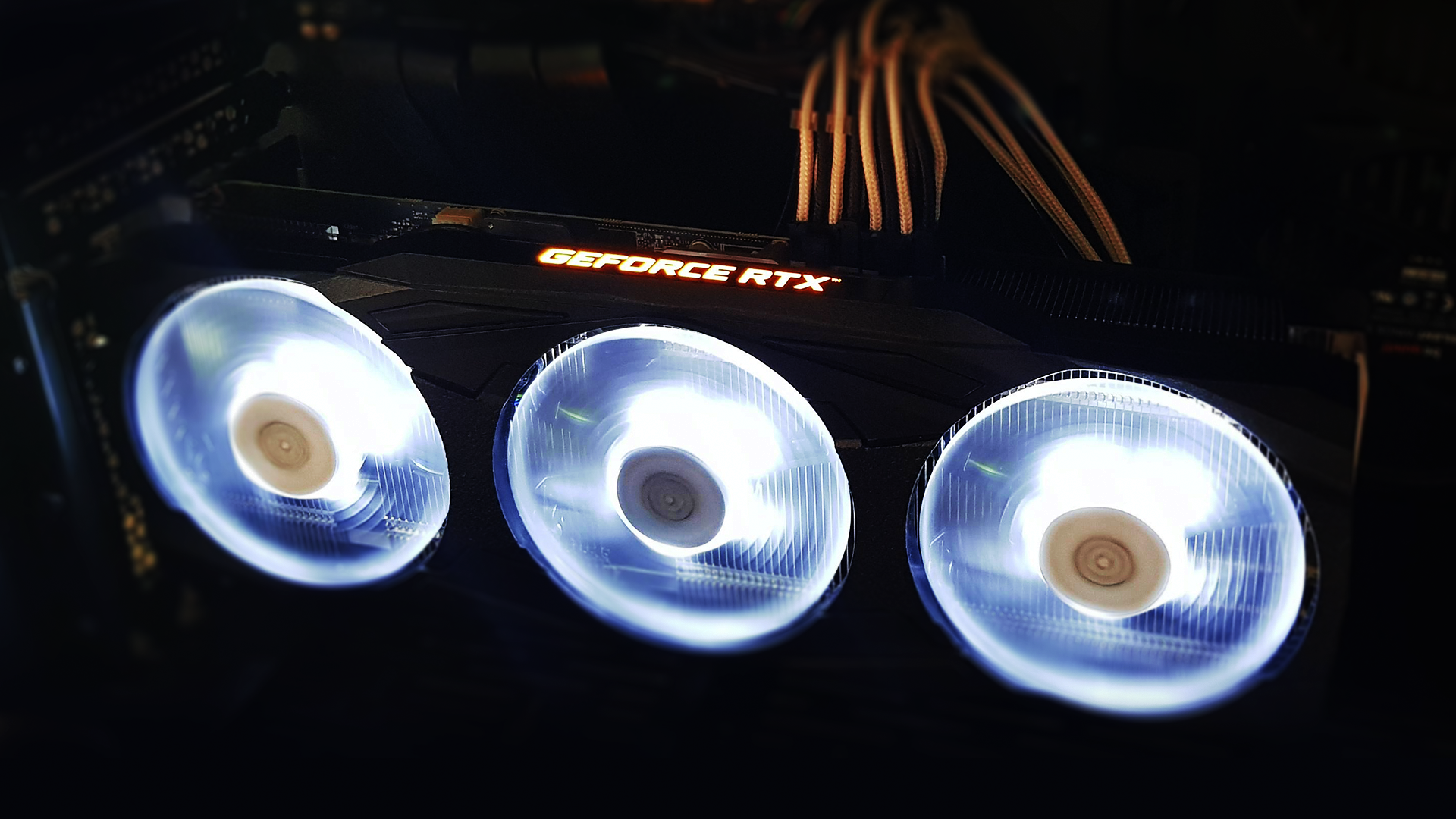
I know what you’re thinking. Ark-what? I felt the same around a month ago when I first heard of the brand. Research revealed an OEM creator for popular hardware primarily intended for commercial use, having also popped onto the consumer market from time to time. And thanks to local site Prestigio, they are coming in at a very decent price and actually in stock! Can you believe it? I didn’t, which is why I asked for the opportunity to check one of these out for myself.
Nvidia’s new GeForce RTX 3080 is an absolute beast of a graphics card, and an unfortunate victim of its own success. Being such a great performer has skyrocketed demand in a time of constrained supply, resulting in a world of frustration for anyone interested. This, combined with the simple fact that most RTX 3080s perform similarly, has made it a situation not of picking your poison but rather of taking whatever you can get.
With this in mind, Arktek’s RTX 3080 Hyperion may very well be a serious budget contender here, though with some notable trade-offs to acquire such powerful hardware at this price.
The biggest trade-off is Arktek opting for HDMI 2.0b instead of HDMI 2.1 for its outputs. This means you won’t get the full benefit of displays requiring HDMI 2.1 – essentially taking 4K 120Hz smart TVs off the table – though gratefully there’s still support for DisplayPort 1.4, meaning most gaming monitors will still be fine.
Another trade-off is the exclusion of creature comforts introduced in more recent third-party graphics cards – things like addressable LEDs, zero-RPM fans, and dual-BIOS. Nope, the Arktek 3080 will run its white-LED-lit fans at all times, though near-silent at under 1000RPM spinning up to a slightly more audible 2000RPM under full load. I would argue this is perfectly acceptable and not at all noisy. On the BIOS side, though flashing is possible, the stock BIOS regularly hits power limits meaning the card is held back somewhat. Having an unrestrained BIOS option would’ve been cool.
The OEM nature of this 2.9-slot chonker of a graphics card shows through its feature set. You are paying for what you get, and so it’s best to focus primarily on performance. And that, my fellow techies, is where this card absolutely shines.
A NOTE ON PERFORMANCE SPECS
The following data was captured on a system running a Ryzen 5 5600X CPU, an Aorus B550I Pro AX motherboard, 16GB of DDDR4-3200MHz RAM, and a Corsair SF750 80Plus Platinum PSU. For shits and giggles, I also ran these benchmarks on my seven-year-old Seasonic 620W PSU, and I’m happy to report the card chugged along without issue.
At no point during benchmarking did the card exceed seventy-eight degrees celsius, often averaging in the mid-seventies in both horizontal and vertical orientations (I have a fancy case).
The best place to start would be synthetic benchmarks, as these are designed to test every aspect of a new graphics card’s feature set. All values captured at stock settings.
3D MARK

While not necessarily standout, these stats are excellent for any RTX 3080, let alone a virtually unknown one. Very impressive from the Arktek, and a surprise to be sure. This puts the Arktek neck-and-neck with more well-known brands, and you could stand to gain further improvements to performance by tweaking clocks, voltage, and fan speeds.
Next let’s look at videogames, which would likely be the real-world use-case for a graphics card (don’t tell me you only bought one of these to run 3DMark LOL). Once again running at stock settings, I’ve gone with a selection of games I feel cover the most common scenarios without creating stats overload. I am not Digital Foundry nor will I ever pretend to be.
HORIZON: ZERO DAWN – ULTRA PRESET

Horizon: Zero Dawn on the PC presents an interesting use-case in that it’s the only game to crash my old RTX 2070 Super consistently while running what I thought were stable clocks and undervolts. For this reason I wanted to see how the 3080 handled it, and sure enough it absolutely ate up the benchmark and spat it out. Not a single crash in sight, and truly eye-watering performance on offer.
RED DEAD REDEMPTION 2 – VULKA, ULTRA, NO MSAA, MEDIUM WATER PHYSICS

I wanted to try out a game that runs well on Vulkan, but not well enough that the card wouldn’t break a sweat. On my RTX 2070 Super getting Red Dead Redemption 2 to run at a locked 60FPS at 1440p took me weeks of tweaking, so you can imagine my absolute shock when all I needed to do here was pump everything up to Ultra and… just, play. Once again magnificent performance at all resolutions, and I imagine this one will be a showpiece for anyone rocking a decent 4K display.
WATCH DOGS: LEGION – ULTRA PRESET

Rounding up gaming performance is absolutely the worst-performing game on my PC, and coincidentally also a game with ray-tracing and DLSS to help me test those features. Watch Dogs: Legion remains a poorly-optimised game that will stretch the 3080 to its limits in order to reach a locked 60FPS. While the in-game benchmark is atrocious, it does show how the game scales with resolutions and with RTX + DLSS turned on/off so I felt it was a worthy contributor here.