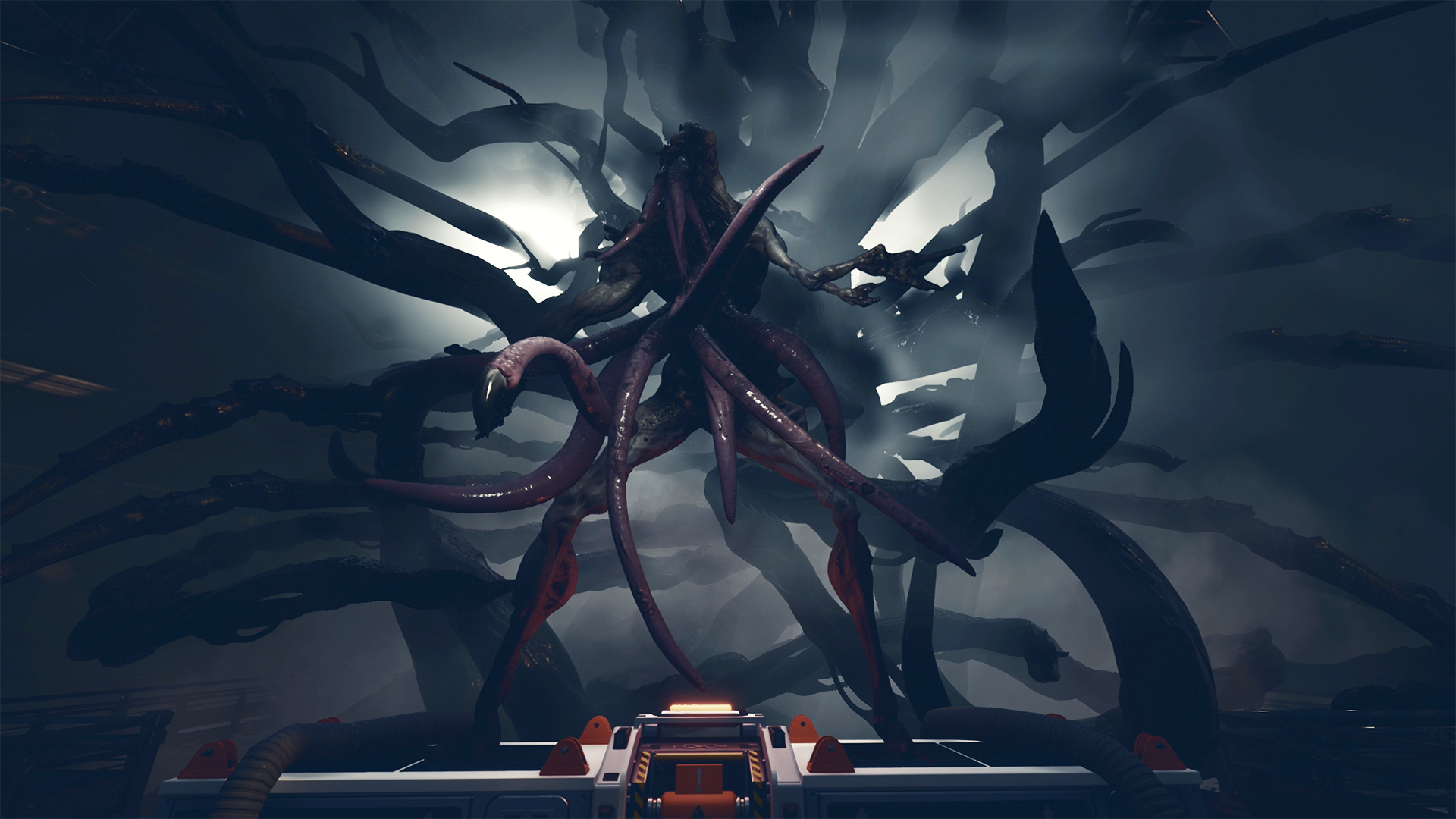
“You had me at horrifying tentacles on Mars” is what I wanted to tell Moons of Madness when, about two minutes into the game, a scary, naked, lank-haired witch did a jump scare on me. Pulled straight from an early-00s horror film, she seemed awkwardly imposed into the evocative Lovecraftian sci-fi cosmic horror I’d been sold on. It’s like biting into a deliciously squamous calamari burger and finding, you know, a scary, naked, lank-haired witch inside.
Thankfully, however, Rock Pocket Games actually manages to weave her into the story in a satisfying way.
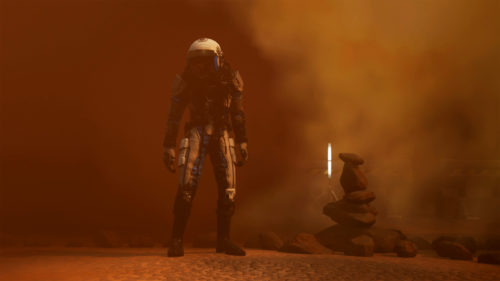
I should mention that I don’t cope so well with horror games. I still haven’t gotten to the part in Alien Isolation where the actual alien shows up. But Moons of Madness is light on the jump scares and gore, and heavy on the existential dread and lore, which suits me just fine. The game is atmospheric and even beautiful at times – its claustrophobic Martian base looks practical and lived-in, while the exterior is stark and breathtaking. The game introduces you slowly with menial jobs like realigning solar panels and fixing leaks, making it that much more personally horrifying (and dismaying) when you return to these areas to find them overrun with gooey grossness.

You’re Shane Newehart, a technician assigned to a research mission on Mars. Things start off as innocently as they can when you’re working for a shadowy organisation called Manticore, but things go wrong soon enough. There are enough “blasphemes”, “fhtagns”, and weird mathematical equations to delight any Lovecraft fan and inspiration has clearly been drawn from genre classics like The Dreams in the Witch House and At the Mountains of Madness.
Moons of Madness attempts to weave several different concepts into one cohesive story and it mostly succeeds. There was one extraneous plotline that didn’t seem to go anywhere, which may just have been because I missed a piece of lore, but I enjoyed the story overall.

The controls are simple and work very well when Moons of Madness is being a first-person walking simulator/adventure game. There’s no HUD and any information you need to see is presented in-world, such as the oxygen meter in your helmet, or the arm-mounted computer that you’ll use to connect to various devices in order to solve puzzles. Shane also tends to speak to himself, which then informs you, the player, of what to do next.
Unfortunately, the latter half of the game is bogged down in a few areas by stealth sequences that are more annoying than anything else. Movement just feels too floaty and slow for these sections and I couldn’t wait for them to be over so I could get back to the actual game. Thankfully, these sequences are short and there aren’t a lot of them, so I just cranked up the gamma until they were over.