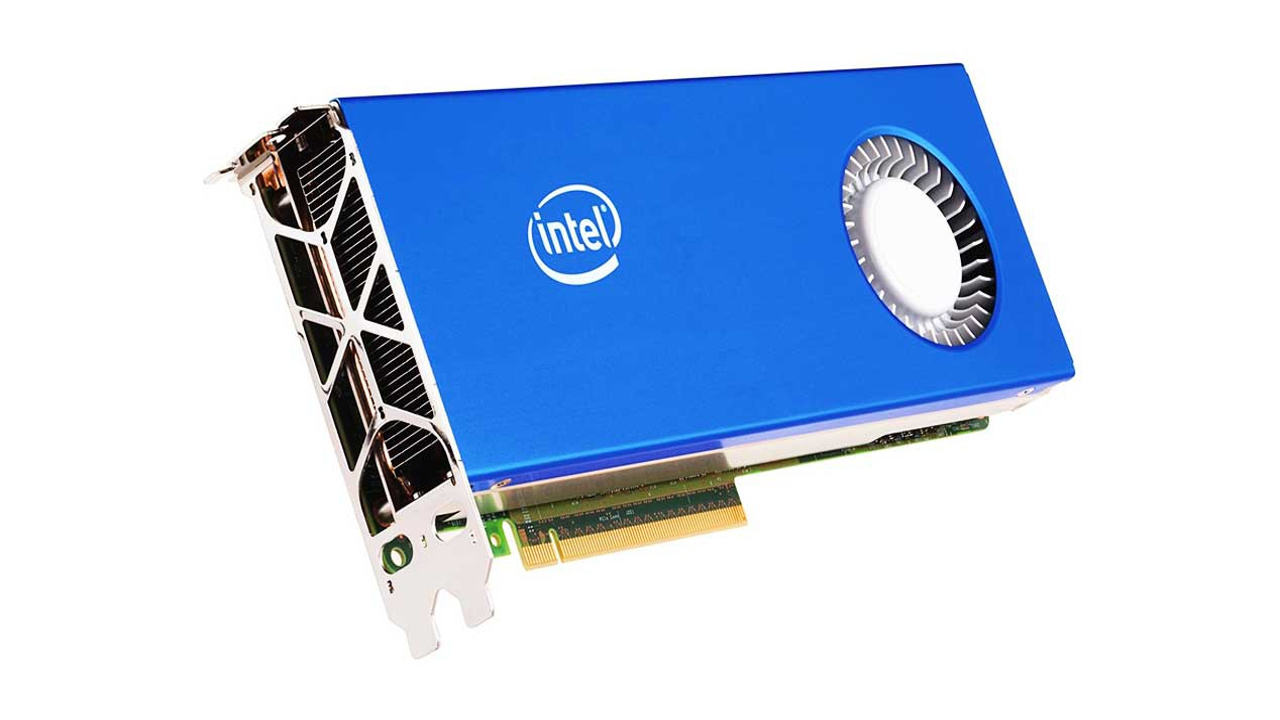

Last week at Computex, Intel put out a very small announcement during their analyst event day that their first GPU was in the works and would be out soon. Beleaguered CEO Brian Krzanich was looking to drop something to journalists that would put out a positive spin on the company’s future, and this little tidbit was it. The last time Intel was in the business of making graphics cards was during the late ’90s, when the Intel i740 was pushed out to convince the rest of the market to use the new AGP bus.
Krzanich announced that the the shipping date for its first GPU would be 2020, which is far enough away to give Intel time to tool up its driver team and get things going on the production side. Intel hasn’t shipped add-in board products directly to consumers for more than five years, as they cancelled and wound down their motherboard development department ages ago. This isn’t counting their M.2 SSDs or their WiFi cards, of course. The graphics team within Intel is reportedly working with Raja Koduri, former head of AMD Radeon Technologies, and is also partnering up with Jim Keller’s team working on advanced lithography processes to reclaim Intel’s process advantage in the market.

When Intel was in the GPU market, their first product was the i740, an AGP graphics card sold for around $100 and meant to bump up the feature set of GPUs in mainstream markets. It didn’t set the world on fire and it also didn’t run as fast as it could have – third party designs that used the i740 would go on to improve its texturing capabilities, increase the amount of VRAM, or do some other clock tweaks to make it run faster. Intel got out of the GPU market as quickly as it went in, cancelling production of the i752 in 1999 and shelving development of the i840 altogether.
Instead, the teams working on these products were reshuffled into Intel’s motherboard department, where they were tasked with integrating the i840 into the motherboard. Intel’s discrete graphics has improved in leaps and bounds since then, but maintains a focus on thermal performance rather than outright graphics leadership. They showed that they could compete with AMD when they announced their Iris Pro integrated graphics chips, and their driver team has been on the ball with updates, keeping up a cadence of day-one driver releases for new games even if the platform can’t play them at high settings or framerates.
Intel did actually make a discrete GPU years back, codenamed Larrabee, but that project was cancelled eventually in favour of the Xeon Phi platform, which took the work done on Larrabee to make a general coprocessor. Linus Sebastian of Linus Tech Tips recently made a video about finding one on eBay, but it doesn’t currently work on the board he tested it on. This isn’t necessarily the direction Intel is going with for their GPUs, but it’s definitely one of the options on the table. Not only was rendering games on about a hundred x86 processors technically feasible, a 2008 technology called SwiftShader, developed by TransGaming, actually had CPUs rendering popular games like Crysis. All you needed to do was scale up the core count.
2020 looks like it’s going to be an exciting year for PC enthusiasts, what with new GPUs coming from AMD and Intel, and possibly a new hardware platform supporting DDR5 memory. All we need now is for DDR4 to start dropping in price and for the miners to stop buying our GPUs!