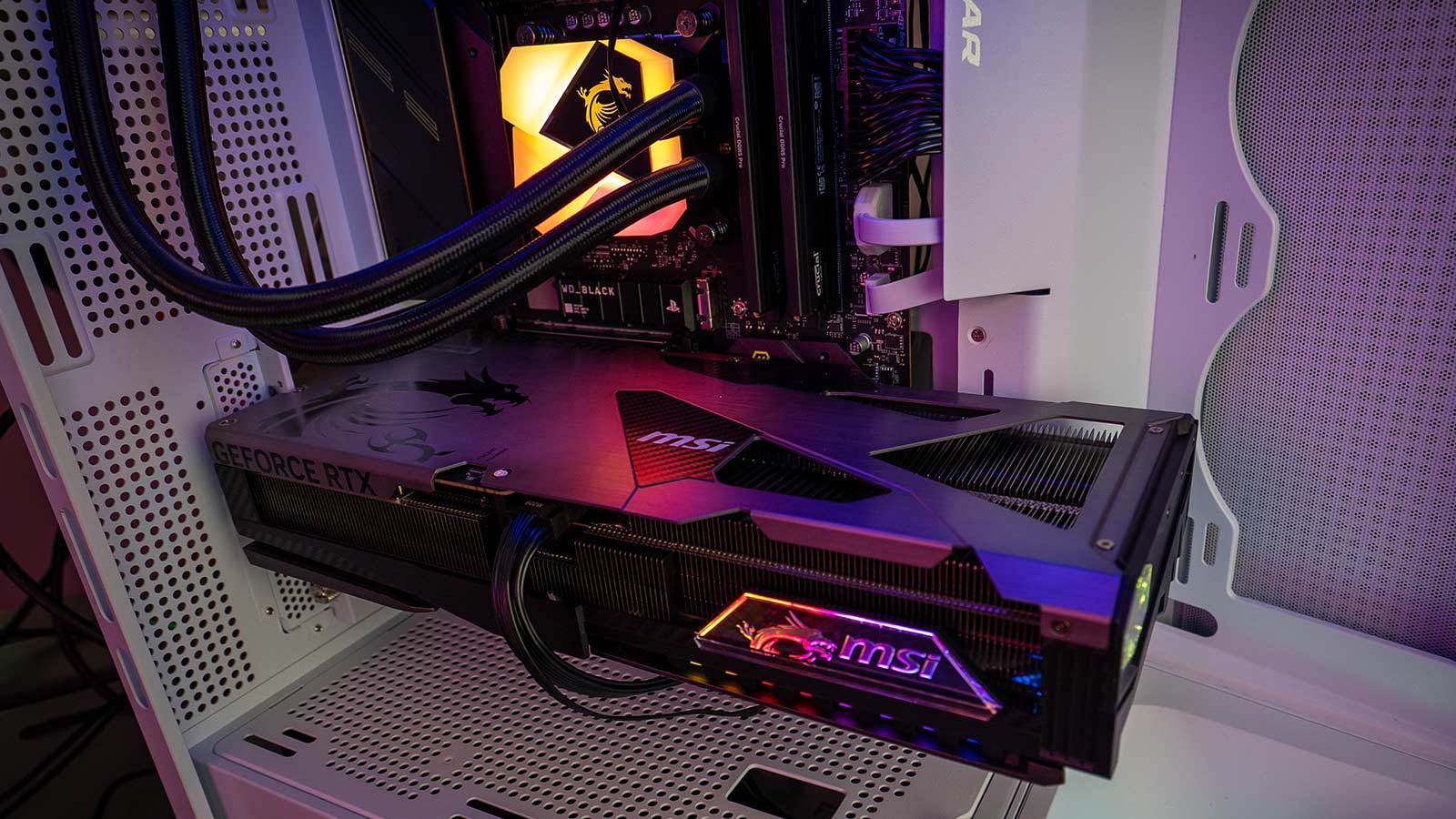
The first month of the year is barely over and we’ve already seen the local launch of one of the most hotly debated graphics cards in recent years.
Nvidia’s GeForce RTX 50 series brings with it a new direction, one that Nvidia has been steering aggressively towards. And let me tell you, it’s not gaming—well, not completely. Let me explain.
The buzzword we’ve not been able to escape and won’t be able to escape ever again is AI, and Nvidia is currently the global leader in the hardware that runs the algorithms.

So, how does this relate to gaming? Well, Nvidia’s GeForce RTX 50 series is the first time we’ve seen such a heavy emphasis on AI calculations for gaming and other uses on a consumer graphics card.
What makes this shift in direction so interesting is that Nvidia believes AI will play a big role in gaming when it comes to frame generation. In other words, software-based image enhancement with the use of AI will become the norm in hitting high frame rates.
Now, this is not a bad thing, but we are seeing the birth of an incredible new technology, and it will only get better.
Gone are the days of seeing double performance boosts year on year with each new GeForce launch. We’ll likely see scaled performance that relies less on raw power and more on neural rendering using Nvidia’s tensor cores. Neural rendering is essentially Nvidia’s method of leveraging deep learning models (using the Tensor cores) to enhance rendering processes, such as image enhancement and frame interpolation.
The MSI GeForce RTX 5080 Vanguard SOC Launch Edition has landed
As you can imagine, I was very excited to get my hands on the new GeForce RTX 50 series. Thankfully, our friends over at MSI hooked us up with the MSI GeForce RTX 5080 Vanguard SOC Launch Edition, and just by looking at this box, you know this card means business.
Modelled on the massively popular blind boxes you can buy everywhere in Taiwain, the MSI GeForce RTX 5080 features a hidden surprise – besides the gorgeous-looking RTX 5080 graphics card, of course. Each Vanguard Launch Edition box includes a limited-edition Lucky figure from the Lucky Around The World series. It’s a really nice little add-on for fans of this cute little mascot.
The business end of this box features the graphics card, a mammoth piece of technology that is one of the most advanced cards available today.

The GeForce RTX 5080 is a high-end graphics card aimed at 4K gaming, but you’ll have an equally good time gaming at 1440p, too. Built on Nvidia’s Blackwell architecture, this graphics card offers a number of advancements over the RTX 4080 and RTX 3080, including a new architecture, increased CUDA cores, faster memory, and higher clock speeds.
The thing is, unlike previous generation upgrades, the RTX 5080 is only about 10% faster than the RTX 4080 in terms of raw computing performance. Compare that to the 14% performance improvement of the RTX 4080 over the RTX 3080 which launched in 2020.
This means that in practicality, you’d get the best benefit of an upgrade if you upgrade from an RTX 3080. Even though the raw performance benefits are not as big as you’d expect but the RTX 5080 holds an Ace up its sleeve, 336 of them.

While both the RTX 40 and RTX 30 series had Tensor cores, Nvidia’s latest GPU not only has a few more at 336 (running at 1,801 AI TOPS) but also runs more than twice as fast in neural rendering workloads like deep learning and frame interpolation.
This means that the RTX 50 series cards are significantly faster with AI-driven processes such as DLSS (Deep Learning Super Sampling) than anything else.
It’s like taking a small step back to push yourself off faster from the starting line.
Enter DLSS 4
The reason why Nvidia’s RTX 50 series is getting criticised for a lower jump in performance compared to its previous generation is that most games and applications have not yet been optimised to make use of these new AI services for which this card has been optimised. Nvidia’s DLSS 4 is the latest. Remember SLI (Scalable Link Interface) from the mid-2000s, a brilliant technology that was let down by broader developer support and the fact that two graphics cards cost more than one.
In this case, Nvidia is taking the bull by the horns and essentially taking the burden on themselves by creating the hardware and software that can upscale frames using AI.
If you’ve ever wondered how AI will integrate into gaming meaningfully, this is it.
AI frame generation was introduced with the RTX 40 series and DLSS 3, but it was limited to single-frame generation. This means that it could only insert a single AI-generated frame between two real frames.
DLSS 4 supports multi-frame generation, enabling multiple AI frames to be inserted between two real frames. This is thanks to the neural rendering capabilities of the RTX 50 series.
TL:DR: The new RTX 50 series and DLSS4 are much better at AI rendering and can insert multiple AI frames between two real frames, resulting in insane frame rate boosts.
Naturally, there is a downside; in some cases, you may notice increased latency or input response, but these type of problems should be solvable as Nvidia’s AI capabilities improve.

DLSS AI Explained
DLSS 4 includes Multi-Frame Generation and Frame Warp technology. Two technologies that will directly improve frame rate output and increase FPS in game:
- Multi-Frame Generation: AI predicts multiple frames ahead, improving motion smoothness while keeping gameplay responsive. DLSS 4 can also better maintain frame pacing by predicting multiple frames at once, unlike DLSS 3, which only inserted a single AI frame.
- Frame Warp: Instead of inserting static AI frames, Frame Warp dynamically adjusts AI-generated frames based on your latest input. As this technology matures, we’ll see the input latency decrease.
This new technology, paired with a shiny new RTX 50 series, means that gamers will see exponential improvements in game quality and frame rates. With DLSS 4, you can expect around a fourfold frame rate boost in an ideal scenario, but it depends on a few factors like the game type, complexity of the frames, and how well it is optimised for DLSS 4.
We’re sitting with a classic case of ‘Technology ahead of its time.’
As the software-based AI improves, we should see solid performance increases in the coming months as Nvidia pushes out new drivers and improved DLSS capabilities. Games supporting DLSS 4 will also greatly improve, especially if older games are updated.
So, where does this leave us now? For one thing, we’re in for a wild ride in terms of gaming graphics and performance. A lower-spec RTX 50 series graphics card should deliver much better performance than the high-end models from the previous generation, but we are not quite there yet.
We are currently busy with our full review of the MSI GeForce RTX 5080 Vanguard SOC Launch Edition, which we’ll publish along with our benchmarks on Monday. For now, one thing is for sure: the MSI GeForce RTX 5080 is a killer, and it sports some insane new AI technologies to improve game graphics.