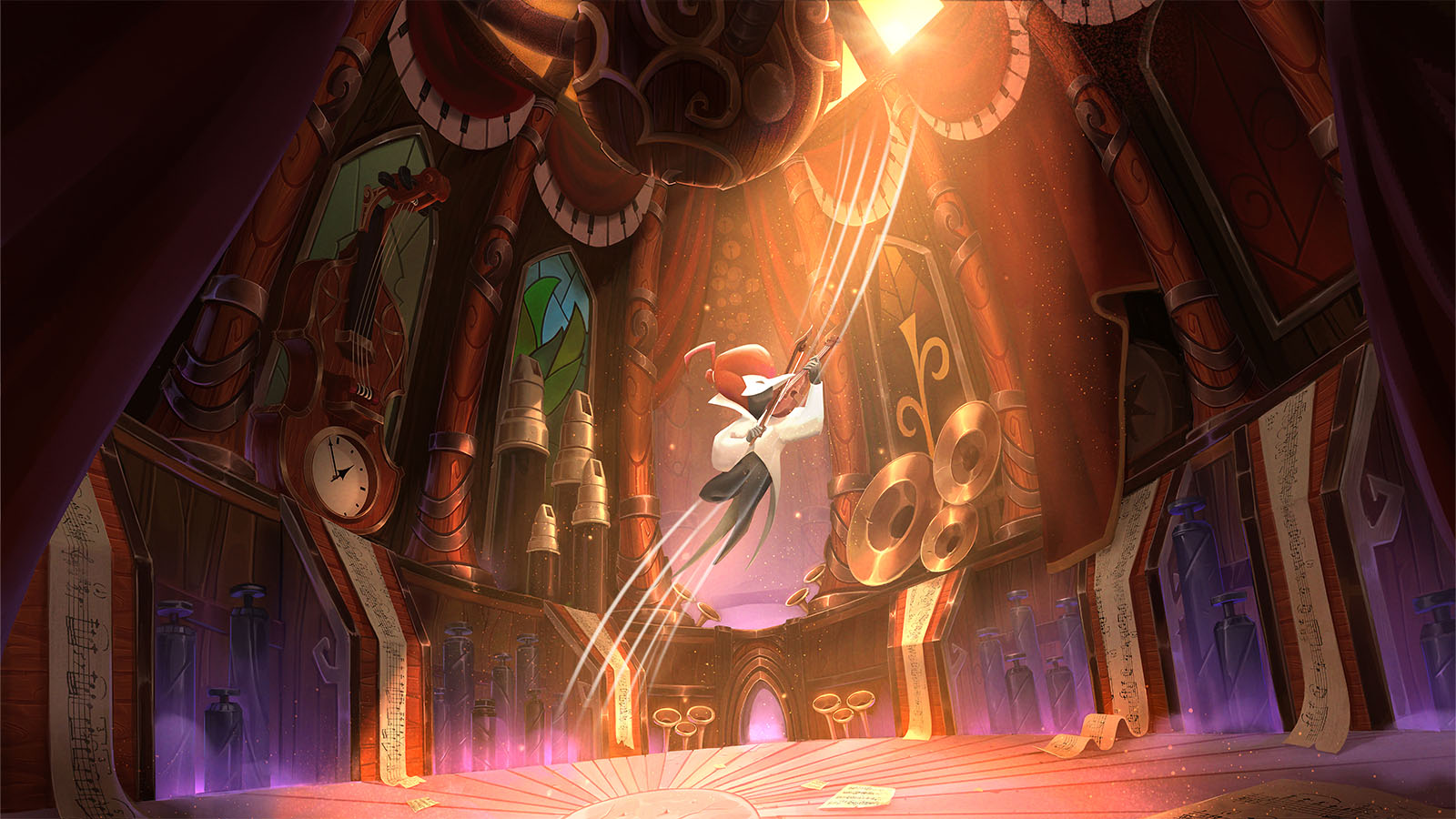
When a game finds its soul in music, something magical happens. Symphonia isn’t just another platformer; it’s a symphonic journey through a world where sound is the breath of life itself, an experience that is felt as much as it is played.
Imagine a place where every note awakens a pulse, pathways bloom in harmony with rhythm, and silence hangs heavy until a single stroke of a violin string brings colour to the void.
This is the haunting, resonant world of Symphonia, a game created by Sunny Peak and developer Simon Larguier, where precision platforming and live orchestration unite in a delicate, dreamlike dance.
I recently got to play the demo for the game. Within minutes, I was transported into a world as fragile as it is beautiful, led by Philemon, a masked violinist who moves not with heavy steps but with a musician’s grace.

In Symphonia, there is no combat, no destructive quest; instead, Philemon wields his violin to restore a world that lost its voice, an elegant contrast to the usual beat-’em-up fare of platforming games. Here, every movement is like a carefully conducted performance, echoing with a desire to rebuild through harmony.
Each musical cue breathes life into intricate mechanics that seem to rise and fall like waves, inviting players into an experience both challenging and enchanting.
When I spoke with Simon Larguier, we delved into the very heart of Symphonia’s creation – the inspiration behind this reverie of rhythm and platforming, the delicate process of capturing a live orchestral soundtrack, and the hopes he harbours for players who enter this silent, yearning world.
Now, I invite you, dear readers, to sit back and join us as we explore the making of Symphonia, a game where music is not just an accompaniment but the essence of existence.

When we think of platformers, it’s easy to envision battles, bosses, and collecting points by mowing down enemies. But that’s precisely where Symphonia sets itself apart.
Developed by a team of visionaries led by Simon Larguier, this upcoming title asks players to swap weapons for a violin and combat for choreography.
It’s a game where music isn’t just a background score but a living, breathing part of the gameplay experience and a project that started as a student endeavour and grew into a full-fledged indie marvel over years of development.
Simon began his journey like many creators: with a passion for storytelling and an affinity for the arts. “At first, I had a good affinity with writing and art in general,” he explained. “Not so much drawing, but mostly narration and creating stories.”

As a student, he gravitated toward game design as a way to bring these interests to life, eventually working with a team of fellow students to develop Symphonia as a student project back in 2019.
The game’s early days weren’t about symphonies or violins, though. Instead, the team started with an intriguing gameplay mechanic: “The original concept was about wielding a weapon, a spear, that would not only defeat enemies but also allow players to launch themselves across walls and bounce off surfaces,” Simon shared.
But as the team explored the idea, a new vision emerged. “At some point, someone in the group suggested, ‘What if the weapon wasn’t actually a weapon at all?’ It was an interesting twist that led us to reimagine our character wielding a violin bow instead.”
And just like that, the idea of Symphonia – a musical journey where the protagonist, a violinist, interacts with a living, musical world, was born.

Once the team decided to step away from combat, they set their sights on crafting an environment that truly felt alive with music. Every part of Symphonia was designed to resonate with the elegance of a symphony orchestra.
“The whole game is built around the symphonic orchestra, right?” Simon emphasized. “Whether it’s gameplay-wise, where you use your violin bow for almost everything, or in the architecture and art style, where each district of Symphonia is related to a different family of instruments.”
Creating this world was no easy feat. It meant tying together not only art and gameplay but also soundscapes in a cohesive way. Each district or level is inspired by a type of musical instrument or performance space, from orchestral halls to theatrical stages, and the game’s soundtrack was crafted to reflect this diversity.
“We decided early on that we wanted to record an actual orchestra for the soundtrack,” Simon said, no small task for an indie team. “It was one of the biggest challenges, but it also allowed us to bring authenticity to the music of Symphonia.”

Combat-free gameplay is unusual in platformers, and creating satisfying movements and challenges without enemies requires some serious brainstorming. The team found their solution in rhythm and fluidity, with the violin bow acting as both a tool and a vehicle for movement.
“We wanted the game to be an exploration of rhythm and traversal rather than combat,” Simon explained. “So, using the violin bow to catapult yourself, bounce off walls, or play music to activate elements in the environment became the focus.”
This shift away from violence meant players would need to engage with the world differently, creating a unique and immersive experience that appealed to Simon and his team’s sense of adventure.
The theme of nonviolence also dovetailed perfectly with the game’s storyline, where players must gather musicians to reform an orchestra and revive a world that’s lost its music. “The idea that music itself is life, that it could restore a broken world – that was the heart of what we wanted to convey,” Simon explained.

For those of us accustomed to music-themed games that revolve around pop, rock, or techno, Symphonia’s use of classical music is a refreshing divergence.
“There aren’t many games that fully embrace classical music,” Simon noted, adding that the team took inspiration from Art Nouveau and Art Deco architecture, as well as iconic structures like Paris’s Opera Garnier, to bring the world to life. “We wanted every area to feel like a homage to classical art and music.”
When it came to platforming mechanics, Symphonia draws from some of the genre’s greatest hits. “Games like Celeste and Rayman definitely influenced us,” Simon admitted, adding that their work also nods to classics like DuckTales with its bouncing mechanics.
But the real magic lies in how these inspirations have been transformed to fit the musical theme, infusing a rhythmic elegance into the traditional mechanics of platformers.

This balance of inspiration and originality is crucial to Symphonia, which has already garnered praise from demo players who compare the game’s aesthetic and atmosphere to unexpected influences like Alice in Wonderland.
“Hearing that surprised us,” Simon confessed. “It’s not a direct inspiration, but it’s really cool to see players making connections we didn’t expect.”
Ultimately, the goal for Symphonia is to resonate with players on a personal level. “To me, Symphonia is about bringing people together and creating something beautiful together – a sort of metaphor for collaboration,” Simon shared. However, he’s also open to players finding their own meanings.
“Everyone has a different reason for liking it, whether it’s the art style, the music, or the way we’ve woven classical themes into the gameplay. That’s what makes a game truly special.”

As we wrapped up, I asked Simon about his favourite games to get a glimpse of the influences shaping his vision for Symphonia. His list didn’t disappoint.
“I’m a big fan of indie games, like Celeste and Chicory: A Colorful Tale,” he said. “But I try to play a bit of everything. Recently, I’ve been playing Sea of Stars, which I backed on Kickstarter, and I got to enjoy it with my girlfriend. Sometimes, I even play simple games that don’t tell a story at all, just to relax. Gaming can be so many things, just like music.”
At the end of the day, Symphonia is more than a game; it’s a heartfelt tribute to music, an exploration of rhythm and space, and a bold deviation from platforming norms.
In a world where combat-driven games dominate, Symphonia invites players to wield creativity and curiosity instead of weapons, taking them on a journey where every leap, every bounce, and every note strikes a chord that lingers long after the screen fades to black.

As our conversation drew to a close, it was clear that Symphonia promises to be more than just a game – it’s a heartfelt experience, an invitation to listen as much as to play, to tread softly and savour each resonant note.
Sunny Peak’s vision for Symphonia reaches beyond the screen. Through every melody and movement, it seeks to rekindle our sense of wonder, breathing life into a forgotten world, note by note.
In a gaming landscape often defined by the loud and the fast, Symphonia reminds us of the power of subtlety, the quiet beauty that can be found in a single violin stroke, and the impact of a simple, unbroken rhythm. It’s a reminder that games, like music, can speak to the parts of ourselves that words rarely touch.
Symphonia is set to release on the 5th of December for PC, Xbox One, Xbox Series X/S, Nintendo Switch, PlayStation 4 and PlayStation 5.