If you picked up your copy of the NAG Winter Edition, you’ll already be familiar with Dustborn, or at least as familiar with it as I was going into this review. Now, in case you haven’t yet seen my feature on the game in the magazine, let me catch you up:
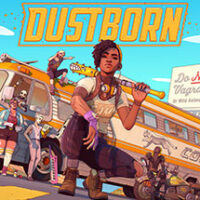
Dustborn is a single-player, story-driven action-adventure game about hope, love, friendships, robots… and the power of words. It was developed by Red Thread Games and published by Quantic Dream, and a South African team worked on it.
But despite talking to the team, feeling their excitement for the project, and getting to look at its super pretty art, I still wasn’t quite sure what to expect going into the game—especially because of how ambitious everything sounded.
But after spending just a couple of minutes in the game, there was something I could not shake: from the get-go, Dustborn felt strikingly different yet oh so familiar. Now, you might be thinking that I’ve finally lost my mind because there is no way that both those things could be true, but they are. Let me explain.
Firstly, the unfamiliar comes in because, a few fun little mechanics aside, Dustborn plays much more like a visual novel or a visual comic than an actual game.

However, it has more depth because it includes a rhythm-based mini-game and some combat—although those never really feel like they’re intrinsic to the game or gameplay.
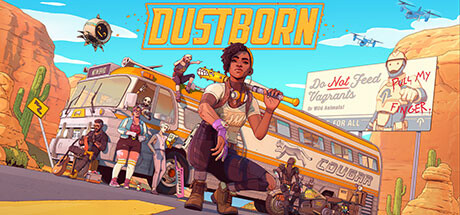
Familiarity comes when you compare the type of character-building and storytelling to other games like Tales from the Borderlands. Not only does it have a very similar approach to how it handles the story, but it also has the same kind of aesthetic and art style – yet somehow, in Dustborns hands, it feels more authentically like a comic book come to life than anything else I’ve played.
Dustborn is also a game that felt accessible to a fault. Not only is there a crazy amount of diversity when it comes to the cast of characters, their backstories and even physical appearance, but Dustborn is also a game that wants people to be able to play it.
Do you prefer playing games on a mouse and keyboard, even though the game recommends a controller? You’ll be fine. If you need subtitles to fully enjoy the game, no worries. You can choose the size, stack them, change their colour—pretty much everything you could imagine.

You can also simplify all the quick-time events in the game and even alter the frequency and intensity of combat. While none of these little accessibility options has any bearing on whether or not Dustborn is a game worth playing, it is a little touch that feels so right for the type of game it is and playing it made me angry that more games don’t try as hard to be accessible because everyone should be able to enjoy playing games.
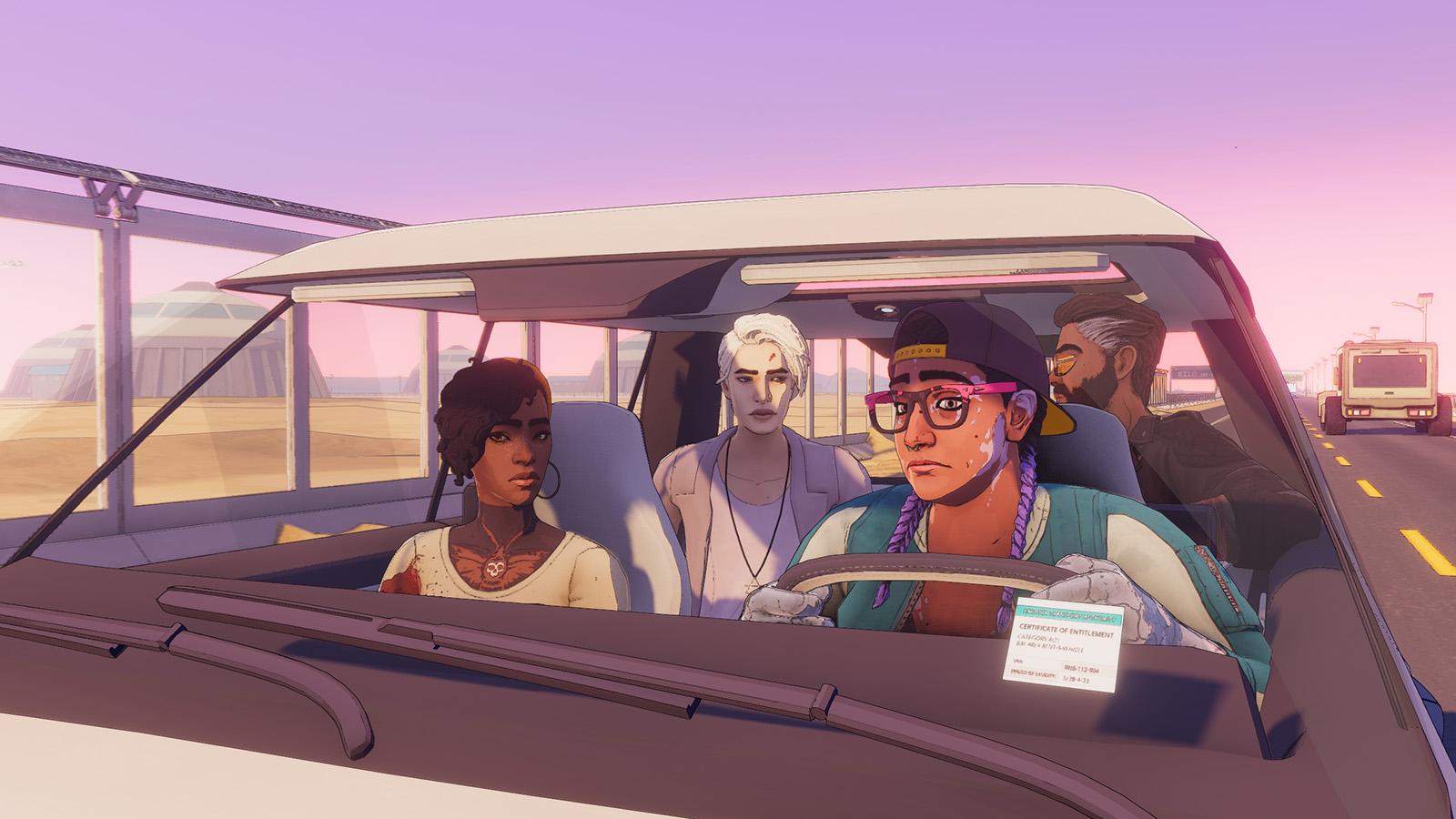
But now for the actual game: Dustborn is a game that has something to say and isn’t afraid to say it. From the get-go, it felt very much like a “hold my beer” situation. The game opens by introducing us to the four main characters. We have Sai, a character with vitiligo whose mood can rapidly change at any moment.
Then we have Noam, a non-binary character with silver hair and a devil-may-care attitude, and Theo, who, at least in my playthrough, quickly became the stereotypical dad of the group. Finally, we have Pax, our protagonist, bound to cause waves.

Not only is Pax a female protagonist (already bound to cause upset among the trolls), but she’s also not your accepted kind of female protagonist – that’s to say that she doesn’t wear any short skirts, dress in an overtly sexy way or look overly feminine. She is also a woman of colour, and to throw a little more controversy in there – she’s also pregnant.
But Pax is so much more than just that description. All the characters are. For better or worse, one thing that Dustborn absolutely nails is how utterly real all the characters and their interactions with each other feel. There is a very real ebb and flow in all the dynamics that really brings the characters to life throughout the game.
Now, I’m not going to touch too strongly on the story because, unfortunately, when it comes to a game like Dustborn, the story is all you have, so spoiling that is doing the entire game a disservice. So, in the most spoiler-free way, I’m just going to say this:
You play as Pax, a woman with the power to manipulate language. Not everyone in this world has powers, and those who do are labelled as Anomal. Pax has been hired to deliver a very important package from Pacifica to Nova Scotia, a long and troublesome journey.

As I said previously, Distborn plays very much like a visual comic. While there are some other mechanics thrown in, like combat and rhythm sections, these are never really the point of the game and instead feel like small little breaks from the core game, which is managing the relationships between a group of people who couldn’t be more different.
Now, it’s time to address the elephant in the room. Dustborn is a political game. It just is. And if you’re not looking for an unapologetic look at the real world in your game time, then Dusborn isn’t the game for you – and that’s okay.
But for those who don’t mind a little politics in their games, there is something utterly refreshing about a game that’s not afraid to call out the politically charged whispers from the far-right and to point out how ludicrous the dialogue is that scientists lie to people and are putting things in the vaccines – and yes, those are genuine things you will hear in the game.

Overall, Dustborn is a game I find incredibly hard to review, and it’s because it tries to be too many things at once. When Dustborn is at its strongest, it leans into its overall message and how the interactions between the characters are navigated and grow.
However, the game’s weakest areas are the rhythm mini-game, which, while fun, never truly fits into the game I was experiencing, and the combat, which always feels like something I just have to get through to get back to the game’s strong point—its story.
But that’s not to say that any of my gripes truly soured my experience; on the contrary, I loved Dustborn, and more importantly, I love what it represents, and I genuinely hope it’s just the start of seeing more games that aren’t afraid of tackling politically charged topics or including a more diverse and dynamic cast of characters.
But that also doesn’t mean that I find Dustborn an easy game to recommend, but somehow, I think that’s the point—anything worth doing will always be hard, and any conversation worth having will probably feel a little bit uncomfortable.
Why Handheld? After playing Dustborn first on the Legion Go and then switching to my PC, I couldn’t help but feel that it’s a game made for handheld gaming. The art style lends itself to the medium, and because the game is played in “chapters”, the natural stopping points are great for when you want to lie in bed and play something before you say goodnight.