There was a time when the DIY community looked down on pre-built PCs, and for the most part, it was justified. Typically, PC integrators would choose components based solely on price, often resulting in unbalanced or unreliable systems in some cases.
While this is still the case with some pre-built machines, fortunately, it doesn’t apply to the PCBuilder – AMD Ryzen 5 5600G PC. With a price point of just R9,999, I expected much worse and was pleasantly surprised by what I found in the machine.
As the name suggests, this PC is built around the AMD Ryzen 5 5600G CPU and a matching platform, including an AM4 motherboard, DDR4 memory, M.2 support, and most importantly, AMD Radeon graphics, which is what qualifies this PC as a gaming machine.
For such a limited budget, this system performs relatively well, largely thanks to the use of a 500GB M.2 solid-state drive in conjunction with 16GB of DDR4 3600 memory. While these components aren’t cutting-edge today, they provide enough performance to ensure a snappy and responsive system.
The one change I would like to see in this machine, and similarly configured ones, is the use of two 8GB DDR4 memory modules instead of a single 16GB module. The reason for this preference is simply performance, and in particular graphics performance.
Since the system relies on an integrated graphics processor, it utilises the computer’s main memory and thus competes with the CPU for memory bandwidth. A simple transition to a dual-channel setup doubles the available bandwidth, significantly enhancing graphics performance as the benchmarks below illustrate. This one adjustment results in a dramatic performance boost without substantially increasing the price, even if that means switching to technically slower DDR4 3200 memory.

Regarding storage, Crucial’s P3 SSD, as previously mentioned, contributes to system responsiveness. That said, it struggles when transferring large files or folders exceeding 50GB, slowing down as it depletes its SLC cache and writes directly to the QLC (Quad Layer Cell) NAND, where write speeds can drop as low as 48MB/s. As a result, it would be wiser to opt for the Kimtigo 512GB M.2 drive for just R25 more. While it may not appear as fast as the Crucial P3 on paper, it employs TLC (Three Layer Cell) NAND instead, ensuring better sustained performance in real-world tests, even after the cache has been exhausted.
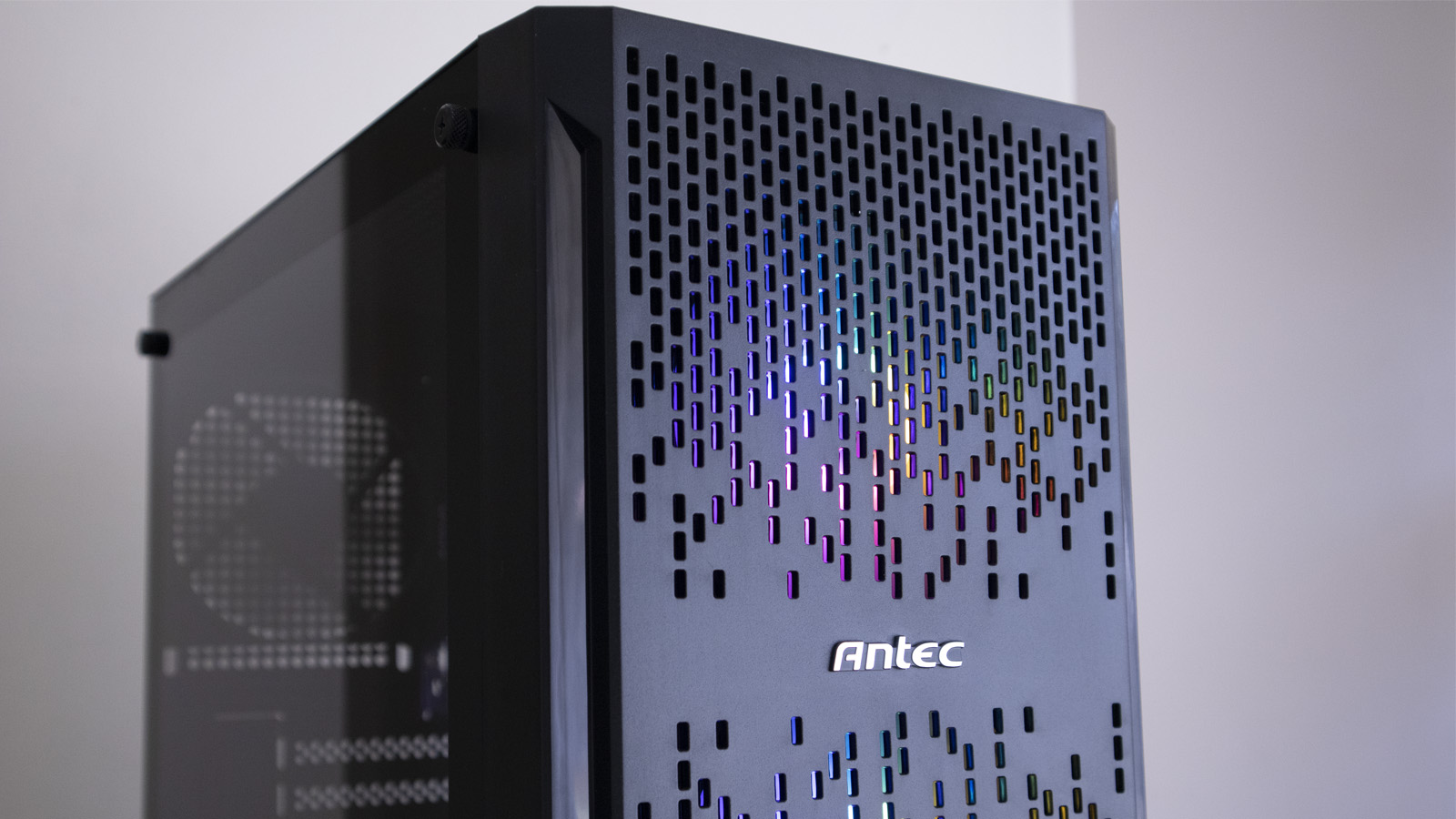
Performance aside, there are no faults to be found in other aspects of the PC. It delivers visually, featuring three 120mm RGB fans at the front and a non-RGB exhaust fan at the rear. A total of four fans may seem excessive for a PC lacking a dedicated graphics card, but you appreciate them when looking at operating temperatures under load. Even under intense gaming stress the system remains cool with CPU temperatures never exceeding 65 degrees Celsius.

The PCBuilder machine also offers significant potential for upgrades, due to the ANTEC NX290 chassis, which to my surprise, is able to accommodate a 240mm AIO. Should you decide to upgrade the CPU in the future, the PC is already equipped for a compatible cooling solution.
Power is provided by a 550W ANTEC unit that’s able to handle recent graphics cards such as the GeForce RTX 4060 TI 16GB or Radeon RX 7700 XT 12GB (based on official PSU recommendations from NVIDIA and AMD).
Setting component selection aside, the cable management in the computer exceptional, especially when you consider the non-modular nature of the PSU. The only cables visible through the windowed side panel are those of the USB 3.0 front panel and 24-pin ATX power cables. This results in a clean appearance while ensuring optimal airflow within the case. It’s a straightforward PC, but the way it’s assembled is quite impressive.

Finally, let’s turn our attention to game performance, which is ultimately the focus of this PC. The initial benchmark ran on the PCBuilder AMD Ryzen 5600G machine was 3DMark TimeSpy. The default score hovers just above 1,000 points but can surge by over 50% when employing dual-channel mode with DDR4 4000. Elaborate tuning on this PC is unnecessary, as its simple matter of selecting the DDR4 4000 profile through the MSI motherboard’s “Try-It!” feature, which configured the system for stable and reliable DDR4 4000 operation.

As illustrated in the benchmarks below, out-of-the-box performance allows you to enjoy games such as Forza Horizon 5 at 35FPS with a 720P resolution. This is decent, but switching to dual-channel DDR4 3200 increases performance by a staggering 62%, raising the average frame rate to 56FPS. DDR4 4000 further enhances performance to reach the coveted 60FPS mark, but the gains are marginal in comparison. As such, pursuing DDR4 4000 speeds isn’t worthwhile given the increase in DRAM voltage, heat generated and overall system power consumption.

The most significant change in performance due to memory occurs at 1080P, which is simply not viable with a single DDR4 3600 DIMM. What renders the game unplayable is the minimum frame rate of only 21FPS. By comparison a dual-channel DDR4 3200 configuration raises the minimum frame rate to 31FPS, a substantial 47% performance increase. This performance boost enables a 1080P average frame rate of 39FPS or if preferred, nearly 60FPS at 720P.

Considering these results, the additional R330 investment for a dual-channel DDR4 3200 configuration is more than justified as it’s not often a 4% increase in cost results in a performance boost of over 50%. In conclusion, the PCBuilder AMD Ryzen 5600G machine stands as a capable entry-level gaming PC that’s highly recommended for those on a tight budget. Priced at R9,999 with a dual-channel configuration, it’ll be tough to find better value anywhere else.