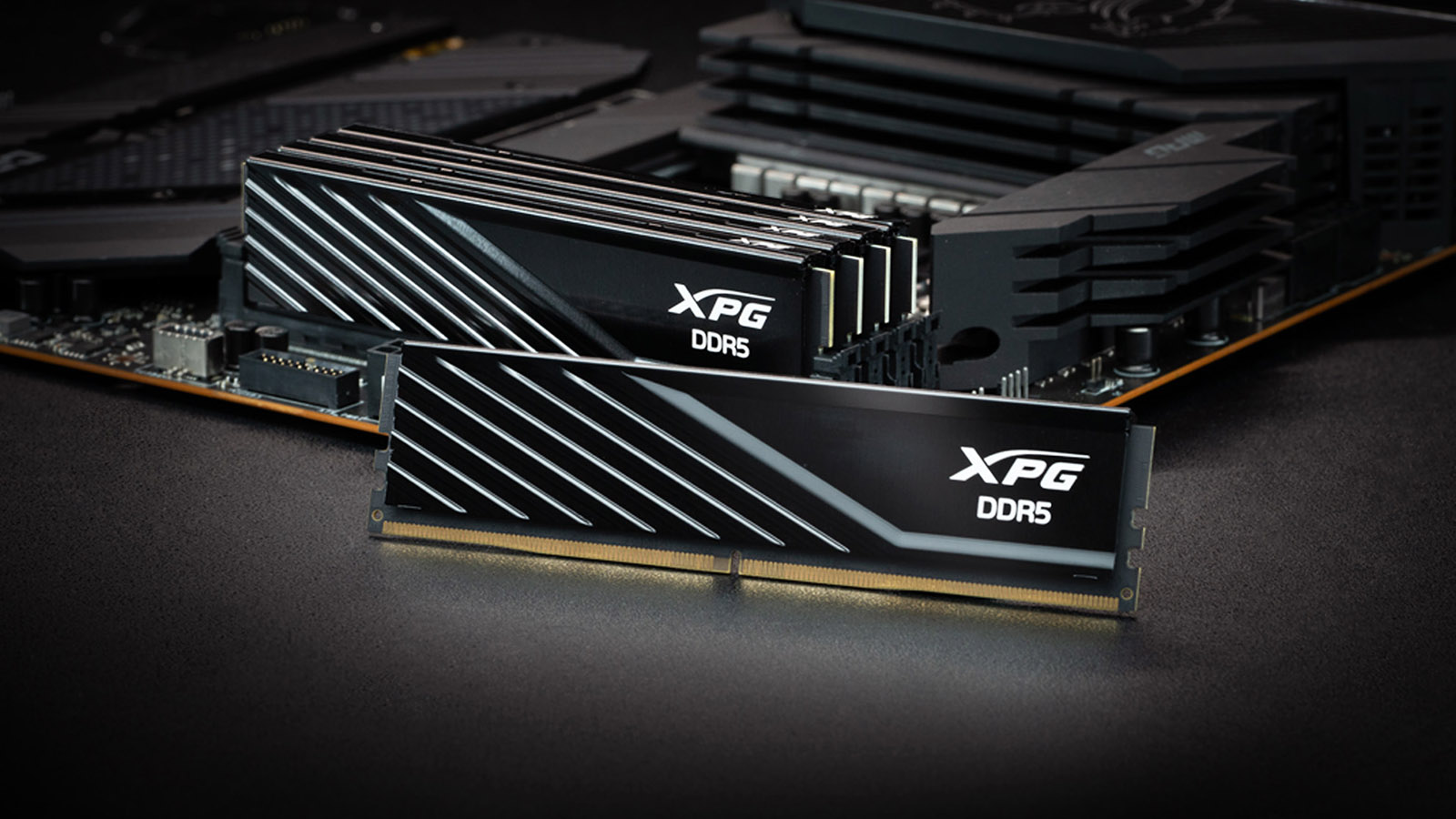
Six months ago, if anyone had asked whether they should transition to a DDR5 platform, my response would have said, “It depends.” The reason for this was simply because DDR5 still carried a price premium over DDR4 at that time. However, as of Q4 2023, that situation has changed, and there’s no better example to illustrate this than the XPG Lancer Blade Series of memory modules.
The memory in question today is the unassuming DDR5 6000 SKU, consisting of two 16GB modules operating at 1.35V. There’s nothing out of the ordinary here, except that this kit retails for a lower price than the more premium and similarly specced XPG Lancer DDR5 series. While we don’t have final pricing information right now, XPG and its various retail partners have informed us that we could be looking at a price of around R2,299, which is nothing short of astonishing for such a capable memory kit.
Indeed, you can purchase entry-level DDR5 4800 memory for less, but there’s no practical reason for anyone reading this to consider such memory. Simply put, there is no motherboard available locally that doesn’t support at least DDR5 6000. Therefore, it’s best to compare the XPG BLADE memory to other DDR5 memory modules with the same frequency and timings, where it stands out not only for its price but also for its tuning headroom.

Out of the box, the timings are impressive enough at CL30-40-40, but that’s not the limit. This memory will continue to scale in performance, reaching an incredible DDR5 7800 on the right motherboard, with impressive CL38-48-48-84 timings to boot. For context, the most affordable DDR5 7800 kit in South Africa costs over twice as much and requires a higher operating voltage of 1.45, which is 50mv higher than what was needed for this memory to achieve the same frequency.
The lower operating voltage of 1.4V should not be overlooked, as the typical 1.45V might overwhelm the heatsinks on the BLADE DIMMs. Thinner and less capable heatsinks were used to reduce the price, which is quite different from the premium Lancer series. These heatsinks, though serviceable, are far from what you’d find on memory exceeding DDR5 7000. It’s worth noting that ADATA isn’t targeting enthusiasts with the Blade series; instead, they are aiming it at entry-level or budget-conscious gamers who simply enable XMP without delving into performance tuning.

Under these conditions, the heatsinks are sufficient, and using better ones would only raise the price without providing any tangible benefit to the end user.
One of the key selling points of this memory, according to XPG, is its height. XPG designed this memory specifically for users of tower coolers, similar to the recently reviewed Deep Cool AK620. They achieve this by using low-profile heatsinks, which result in a memory height of just 35mm. However, due to the presence of a light diffuser, the RGB variant makes the DIMMs 40mm tall, which is taller than some regular DIMMs. Unfortunately, XPG’s intentions of creating low-profile memory are defeated by the RGB SKU.
That said, should you use a compatible cooler, the air moving around the socket will help cool the memory and assist the less-than-stellar heatsinks in cooling the DRAM ICs.

For more adventurous users solely considering this memory from a budget and performance perspective and using an AIO, please ensure that you have some airflow around the memory. PMIC hub temperatures can reach as high as 61°C, even with a fan pointed directly at the memory.
In all fairness, though, such a temperature is likely a worst-case scenario as it was recorded under an intense synthetic load designed specifically to place an unrepresentative burden on the memory. Moreover, this 60°C temperature was only observed at 1.4V and DDR5 7800. Under gaming loads or reduced speeds, temperature should not be an issue.
Regarding performance, the XPG Lancer Blade 32GB DDR5 6000 memory impresses, delivering numbers surpassing what should be achievable with an undeniably entry-level kit. What’s remarkable about this memory is that its performance isn’t limited to high frequencies alone. At DDR5 6800 and the standard 1.35V, timings can be tightened to increase performance without needing a motherboard capable of high-speed memory operation. There’s ample room for tuning and realistically, the limit will likely be your CPU or motherboard rather than the memory.


At the time of writing, pricing was being finalised for our region, but according to ADATA, it should be more affordable than the premium Lancer kits by a significant margin. Therefore, the memory could be even cheaper than the previously mentioned R2,299. Even at this price point, the XPG Lancer Blade 32GB DDR5 memory would make for a worthwhile investment. With memory kits like these, the argument for investing in a brand-new DDR4 platform solely because the memory is cheaper is no longer valid. In terms of value for your money, the XPG Lancer Blade is nearly impossible to beat.