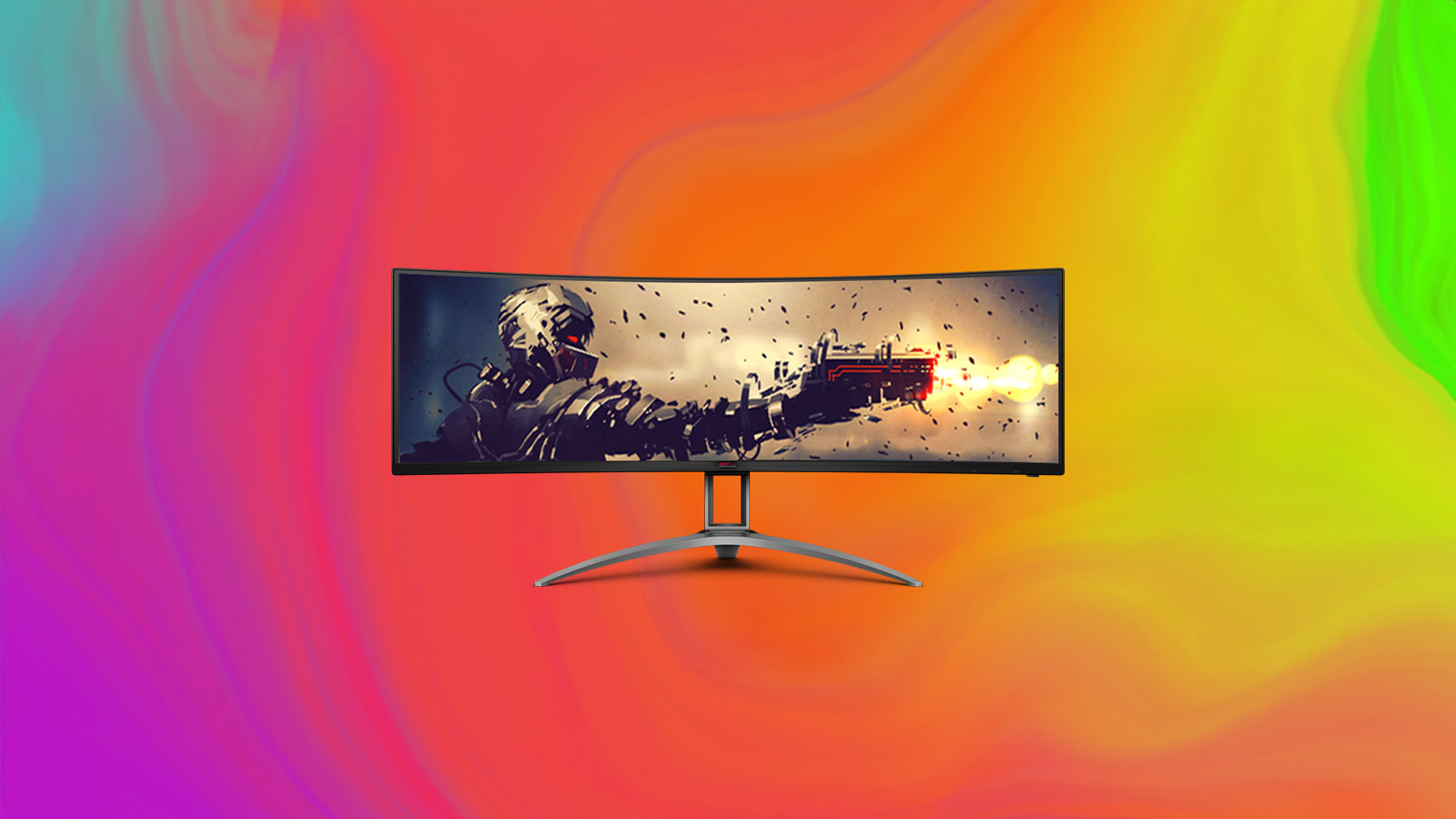
It’s remarkable that thousands of monitors exist on the market, varying in sizes, aspect ratios, panel types, refresh rates, and more, all of which can legitimately claim to be gaming monitors. Even more remarkable is that, to some degree, we all understand what the term means, or at least, we’d like to believe we do. That said, if any display is going to claim legitimacy as a gaming monitor, it has to be this one: AOC Agon AG493UCX2.
Impressive at 49 inches, it occupies most of this real estate along the horizontal axis, boasting a gigantic 5,120 pixels in width over a 1,440-pixel height. This results in the unusual 32:9 aspect ratio, which, outside of gaming, unfortunately has limited support. In fact, testing for this review, outside of games, had to be conducted using YouTube content specifically designed for such an aspect ratio.
However, the lack of content that will fill up the entire display shouldn’t deter you from considering the UCX2 for your gaming needs. After all, the primary purpose of this display is gaming and, in particular, racing sims, where it offers a transformative experience that simply can’t be reproduced on a traditional 16:9 display.
Ultimately, the Agon monitor aims to provide an uncompromising gaming experience for these racing sims, and it does so in several ways, starting with the 1800R curve. An 1800R radius is subtle on displays smaller than 32 inches and often barely perceptible. On such a widescreen, however, it’s noticeable and provides the perfect curve which wraps the image around your vision, increases immersion and limits colour distortion towards the edges.
 As a way of immersing players into the gaming world, I’ve yet to encounter a better experience. It’s something one has to experience in person to fully appreciate. Driving at astonishing speeds through Forza Horizon 5’s vistas is nothing short of incredible. It is without question the title which sold me on this monitor.
How the monitor achieves this goes beyond the screen size as it features Freesync premium Pro (Variable Refresh Rate) compliance, a 165Hz refresh rate and HDR400 support. It ticks all the boxes one would expect for a monitor at this price point and then some. It must be said, however, that the HDR implementation isn’t as impressive as it should be, but is serviceable and worth using on select titles when configured correctly.
The unit makes use of a VA panel, but that alone doesn’t reveal much, considering the many gaming monitors utilising this panel technology. The Agon unit, fortunately, is one of the better experiences producing a pleasing image in both picture clarity and colour reproduction. This was surprising as I initially expected the monitor to struggle with this. That said, synthetic tests using a pattern generator, Colorimeter, or software will produce a less-than-perfect report, but remember that the most important test for a display will always be your own eyes. Purely because what we find visually pleasing often diverges from technically accurate image reproduction. It is closely linked to our gaming environment, artistic preferences, and various other subjective factors.
The Agon monitor’s image may not rank as the best I’ve experienced, especially in the world of OLED alternatives. However, it is good enough that I believe most people would happily make it their primary monitor. This is particularly true when you consider its KVM switch capabilities as well, which add to its practicality.

Please note that if you’re not wall mounting the display, you’ll need a sizable desk because the base has a large footprint, making it unsuitable for smaller desks or tabletops. There are several other factors to consider as well when it comes to the Agon monitor, and that’s retail price, which is anywhere from R30,000 to R36,000. There’s no other way to put it, but in this price bracket, there are some formidable competitors that may not offer the same aspect ratio but do provide OLED panels, higher refresh rates, a better UX, and sometimes all of this at a lower price. In the face of such stiff competition, the Agon monitor is hoping that its strengths will give it an edge.
From my perspective, I believe this monitor has merit beyond the gaming context. For tasks like arranging video editing timelines, working with multiple windows, and just sheer comfort, the UCX2 stands out. With displays of 43 inches or larger, and due to my proximity to the screen, I have to tilt my head upwards for hours on end, resulting in neck strain. Thus, I find myself using mainly the bottom half of such a display, which means I lose out on desktop real estate. So, while the Agon monitor gives up a lot vertically, it more than makes up for this in width, which is useful in many more scenarios.

Now, let’s address the weakest aspect of the Agon monitor, which tarnishes an otherwise outstanding experience: Agon’s OSD (On-Screen Display) and the overall user interaction with the screen. To be blunt, it boasts a garish user interface, made worse by the five buttons located beneath the lower bezel. In all honesty, the less said about it, the better. Fortunately, there’s a remote control that mostly eliminates this frustration. However, it doesn’t rectify the issues of a UI that falls short of what a product in this price range and of this quality deserves.
For competitive FPS gamers, this monitor is obviously not the right choice. Not only will you not be able to use the additional horizontal real estate, but there’s also the challenge of input lag. While it isn’t a concern for most users, those with heightened reflexes and sensitivity to such issues may find their performance compromised as input lag in real terms can be anywhere near 6 to 8ms. Therefore, this monitor is better suited for sim racing enthusiasts, where very few monitors can rival the experience on offer here.
Price aside and under the right circumstances, the Agon AG493UCX2 delivers an unparalleled gaming experience that is truly exceptional.