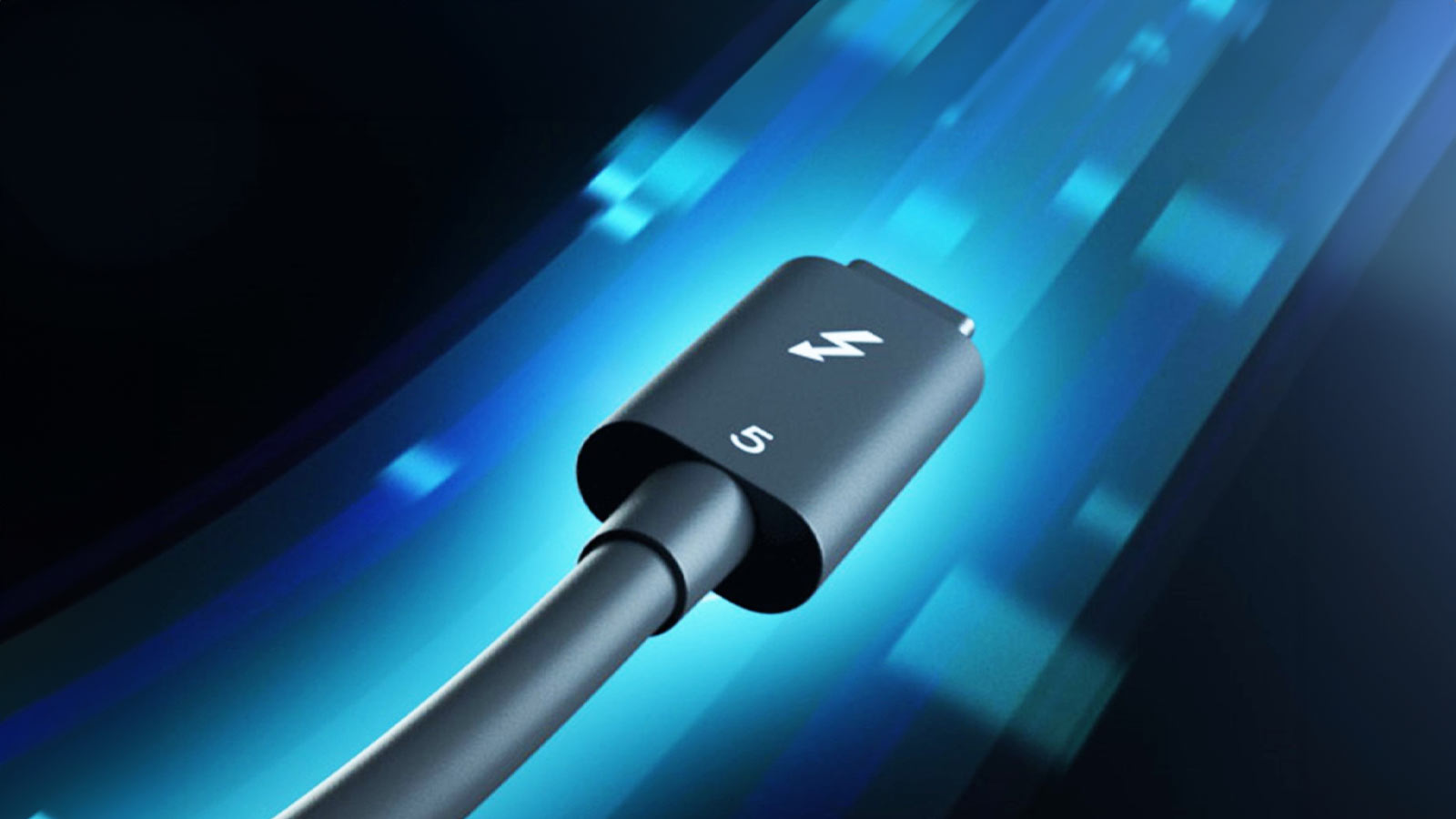
Intel unveiled Thunderbolt 5 yesterday, marking the next generation of Thunderbolt technology and promising faster transfer speeds for us ordinary folk.
A key highlight of Thunderbolt 5 is its significantly increased bidirectional bandwidth, now reaching 80Gbps, double the capacity of the existing Thunderbolt 4 specification. Furthermore, Thunderbolt 5 introduces what Intel terms “Bandwidth Boost,” offering up to 120Gbps for displays. To put this into perspective, that’s enough bandwidth to support three 4K monitors, each operating at 144Hz.

If all of this seems familiar, that’s because USB4 V2, introduced in October 2022, offers identical capabilities, including an optional 120Gbps data transfer mode.
While there have been no physical changes to previous versions, at a signal encoding level, Thunderbolt 5 has shifted from the previous 128b/132b method to PAM-3 (Pulse-Amplitude Modulation). This method of transmission allows three bits of information for every two clock cycles and is what allows for significantly improved data rates.
Data throughput aside, Thunderbolt 5 is a smarter standard, while like USB4 V2, employs the concept of protocol tunnelling. Protocol tunnelling allows the simultaneous operation of multiple independent protocols over the same physical interface. Consequently, Thunderbolt 5 can tunnel Enhanced SuperSpeed USB (USB3), DisplayPort (DP 2.1) protocol, and PCI Express (PCIe Gen4) for load/store operations concurrently. In practical terms, this allows you to connect one or more 4K displays, external SSDs, and other devices without compromising the required bandwidth for each.

Unlike USB4 V2, Thunderbolt 5 primarily caters to the needs of content creators, gamers, and professionals. Therefore, it mandates what USB4 V2 only considers optional. In other words, Thunderbolt 5-certified devices must support all applicable bandwidth allocations and functions. This difference in approach is what gives Thunderbolt 5 an advantage over USB4 V2, which is susceptible to wildly different devices all claiming compliance.
Last but certainly not least, Thunderbolt 5 supports charging up to 240W for notebook PCs and 15W for other devices. USB4 V2 can technically support 240W charging. However, it requires the extended power range mode, and for devices, it only specifies a minimum of 7.5W support.
Overall, Thunderbolt 5 offers a robust and reliable standard for device manufacturers and end users alike, eliminating much of the uncertainty and guesswork involved with USB4 V2 and other standards.
Intel has stated that Thunderbolt 5-compliant devices are expected to hit the market in Q1 2024.