When you’re reading this, know that I sat for a good couple of hours just staring at a blank document trying to figure out how to take all the thousands of thoughts rolling around in my head and corral them together, and then get them out of my head and onto the document. It’s been like playing a game of Lemmings but with my thoughts.
I’ve spoken before about how I don’t enjoy writing reviews about games that aren’t great. And by that, I don’t mean games that aren’t for me; I recently gave Street Fighter 6 a fantastic review, even though I would never play the game of my own volition. No, I don’t enjoy discussing a game that’s objectively bad.
If I had to sum myself up in a single word, it would be passionate. I’m passionate about things that I love, and that’s why I love my work because it gives me a chance to sit here and share some of what I love with you, and hopefully, that love spreads from there. But when I sit down and play something with less passion than me when it’s time to clean the house, my soul leaves my body and dies just a little bit.
That was the case when I sat down, put on my PSVR 2 and loaded up Humanity VR. Now I’m a big reader, and a quote by one of my favourite authors, Stephen King, sums up my problem with Humanity VR. Stephen King once said that if you want to be a good writer, you must ensure you’re reading. In the same way, if you want to be a good artist, you must consume art.

This leads me to my point: if you want to be a good game developer, you need to be playing games. There’s no way around that, and Humanity VR doesn’t feel like a game created by a gamer.
Before I go any further, I want to say that my review is purely based on the VR part of Humanity and not the regular game. So if you’ve played the regular game and have a different opinion to what I have, don’t come for me – my review is VR specific.
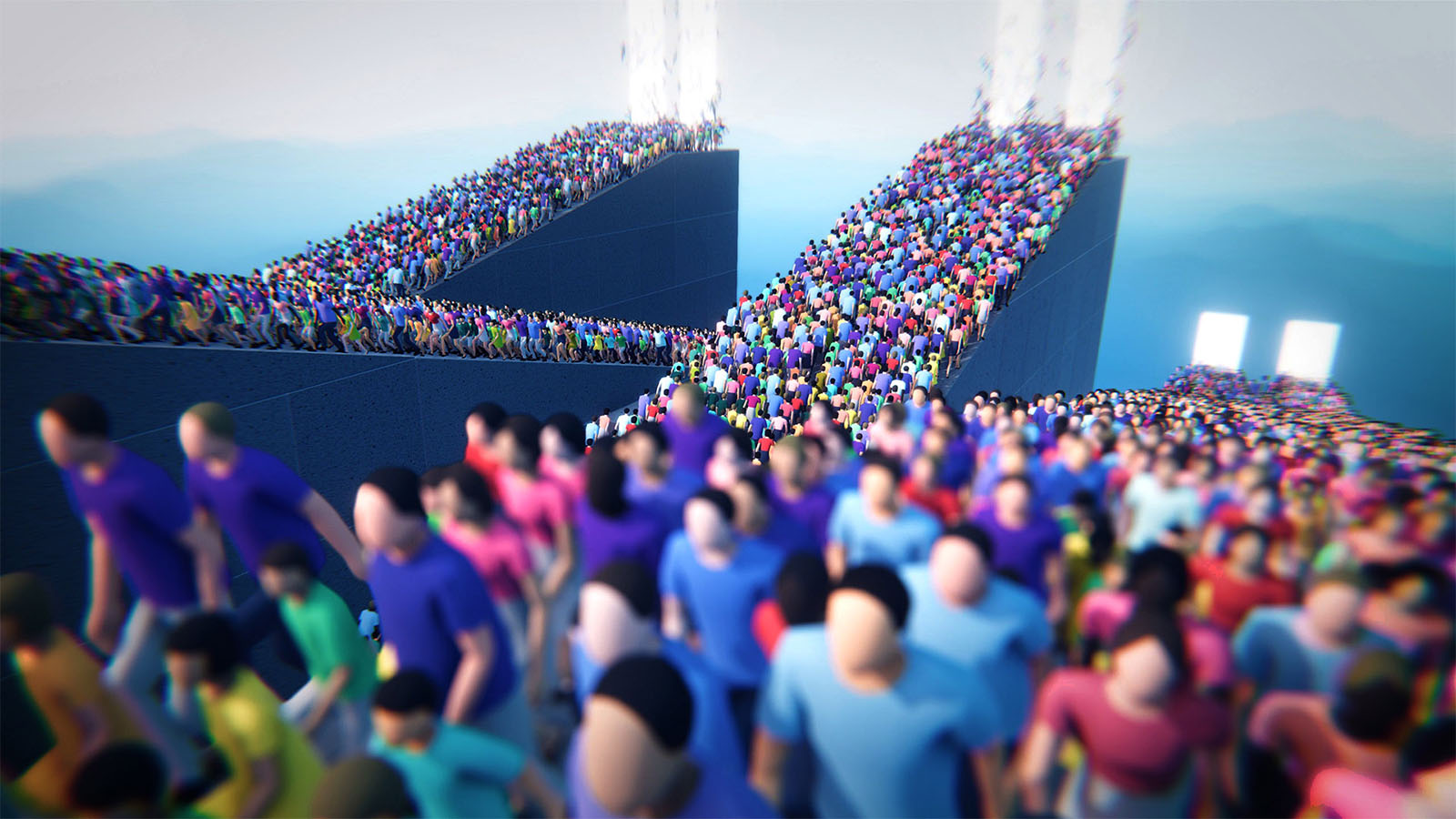
At its core, Humanity VR is a game that puts players in the role of a spirit dog whose job is to act as a guide, leading an endless stream of humans from one side of the environment to another. I think the purpose of this is to show the humans to the afterlife, but honestly, I just wasn’t invested enough in the game to take note of a story so weak it’s like drinking a cup of hot water with the teabag still safely in the box it came in.
To achieve this, players will move the dog around the level using the analogue stick on the left-hand Sense Controller while using the buttons on the right one to place commands for the humans to follow. If you’re old enough, you can think of this game as a new version of Lemmings, but without much of the classic’s charm.

Most of your time will be spent trying to prevent the humans from plummeting to their doom, with each level that progresses becoming more challenging and the humans becoming more and more stupid. In theory, this gameplay loop should feel satisfying to puzzle lovers like me, and adding VR should add the next level of emersion.
I compare this to playing Moss with the PSVR 2 and being able to change your view depending on where you looked, which made the whole game come alive. Unlike Moss, though, the VR in Humanity adds precious little to the game.
Instead of Humanity VR feeling like a complete and robust VR experience where I can become immersed in the world, it feels like a cumbersome way to play a game that was never intended for VR to begin with and does nothing to try and hide that fact.
Unlike other VR titles I’ve played, your freedom of movement in Humanity VR is almost non-existent because players are permanently anchored to the spirit dog by some invisible leash. Players wanting to lean in, inspect something closer, or get a better angle of view will find themselves sorely disappointed.

The art is also nothing to write home about, and while I don’t think it would have bugged me if I was playing the regular version, in VR, I want what I look at to look good.
This brings me to another niggle I had; because of the limited movement in the game, it’s almost impossible even to try and appreciate what the designers created without your dog falling off the cliff. If you somehow do manage to get into a good viewing spot, the level will disappear from in front of you because the game reckons you are too close.
Ultimately, Humanity VR isn’t bad because the game was too technically ambitious, the story was too detailed to pull off, or because they pushed themselves when it came to the art or the complexity of the puzzles. Instead, the game is bad because it just exists in the dullest way possible without even an iota of passion to seep through.