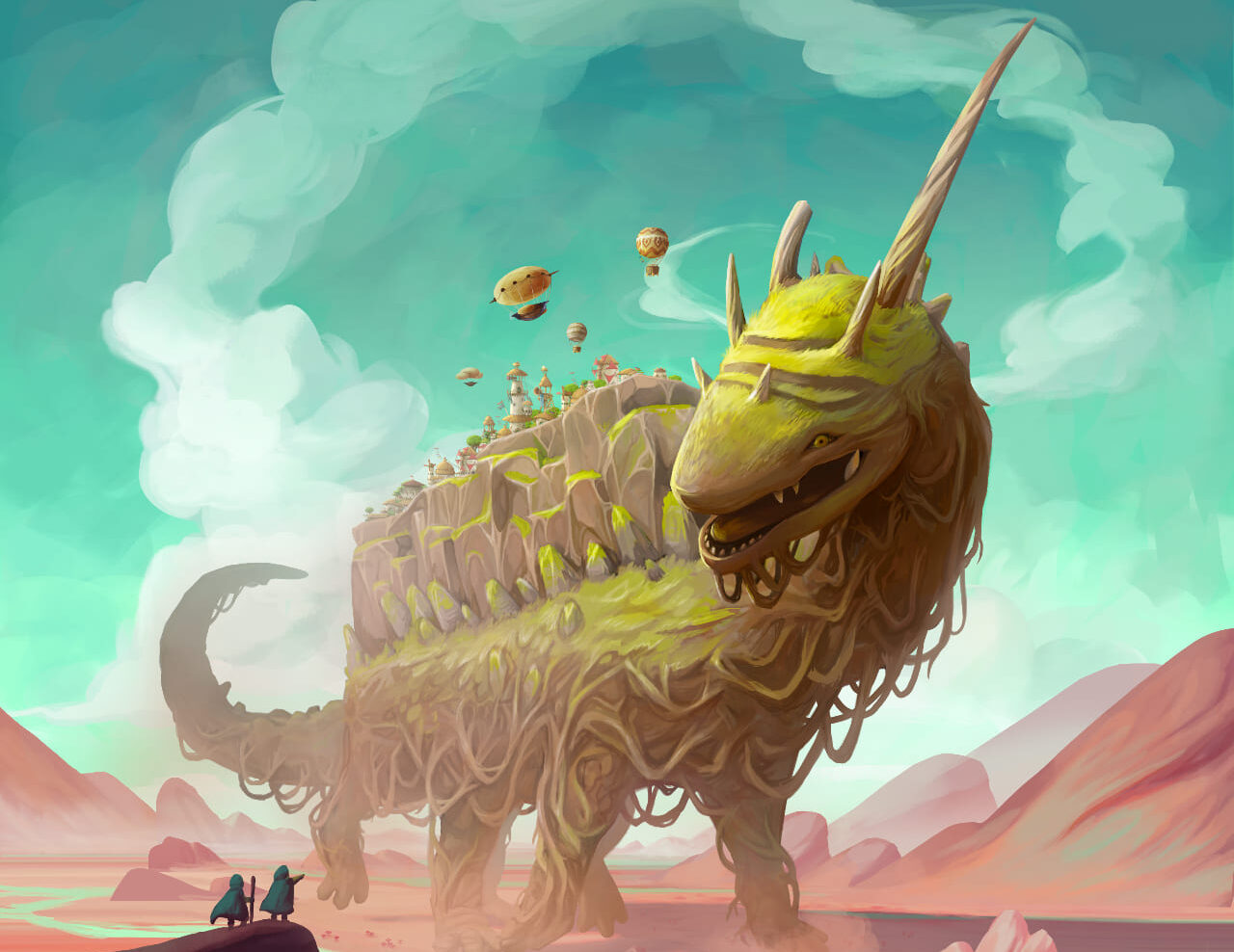
Hitting Steam Early Access soon is The Wandering Village, a unique take on city building/colony sim games. You take charge of a village on the back of an Onbu, a giant creature slowly travelling through a procedural-generated map to escape toxic spores infecting the world.
Build your village, interact with the Onbu (Japanese for “piggyback ride”), and those spores away. It’s a great indie game with hints of Frostpunk and Studio Ghibli, built in collaboration with a vibrant community.
NAG chatted to one of the developers at Stray Fawn Studio to find out more…

Hi Philomena. Could you please introduce yourself to our readers?
Sure! Hi, I’m Philomena Schwab. I’m the co-founder of Stray Fawn Studio and the project lead of The Wandering Village. My job in this specific project is to do the game design, project management, and marketing, mostly.
How big is your studio?
Around 10 people, but some are part-time. So it’s more like seven or eight full-time employees.
Development teams are getting bigger and more complicated. Is it nice to work in such a small focused team?
Yeah, I really liked it. If our studio grew bigger, I would probably prefer it like [Don’t Starve Together developer] Klei did. After they became very successful, they split their development team into three or four teams of around 10 or 12 people, instead of making one really big game.
Let’s look at The Wandering Village. What is it about?
It’s a city-building game on the back of a giant wandering creature. It’s a game about symbiosis where the people and the creature have to somehow survive together even though their interests are not always aligning.

This is your first city builder/colony sim. Why did you choose this genre?
We really like to make simulation games and so we just moved our way through the simulation game genre. Our first game was a turn-based strategy simulation game. The second was an action simulation game.
Where did you get the idea for The Wandering Village?
My business partner and I were at an exhibition and saw concept art of a creature with a city on its back, as you often see in pop culture and mythological references. We stopped and looked at each other and both said at the same time, “Oh, that’s the kind of game I want to make!” We researched a little bit as to what other city builders are creature-related and we saw that there are some games that have big creatures as a setting but never as a game mechanic.
Working with the creation, the Onbu, is a big part of the game. How did this idea of symbiosis develop?
It was my turn to take the project lead, and if you let me take the project lead you usually end up with a biology-inspired game! I’m very interested in biology. I couldn’t originally decide if I wanted to study biology or game design, so I started game design. But I made a biology game as my final thesis, which then was our first game. The concept of The Wandering Village feels very biological, right? You’re on top of a living, moving thing. Rather than give players multiple creatures, I want them to really feel the impact that they have on one creature, and have more of a long-term relationship with it. I just researched a bunch of different methods for symbiosis and parasitism. And they proved to be very interesting game mechanics.

The Onbu is more than just a moving piece of land. You can build a rapport with it and that really influences your situation.
Yeah, definitely. A lot of people are really falling in love with the Onbu and want to make sure it survives. But you can also do a bunch of parasitic things. So you can, for example, build a blood pump on the heart and take out the blood and turn it into food. And if you do too many things like that, the Onbu will start to dislike you. It can even shake, trying to get rid of you. Then you have a big earthquake in your city and need to rebuild a bunch of stuff. We also added a lot more mechanics into the direction of short-term benefits, and longer-term type problems. Every run can be different.
Do you want the players to try and be symbiotic? How open-ended is this?
No, they don’t have to be symbiotic. It can be the easier path to be parasitic. It’s usually mostly your moral sense that tells you what you should and shouldn’t do. In the early access version, it’s really mostly about surviving as long as you can. There are different endings depending on how you treat your people and the creature. But that’s a very small thing at the moment. During early access, if everything goes well, we are hoping to add more of a story so that you also understand more of the lore of the world and what happened to it. Maybe that might be a reason to reconsider your parasitic lifestyle. But the game doesn’t push moral decisions onto you.
What kind of updates do you have in mind during Early Access?
We promised a bunch of features such as new biomes and other things. Then usually we look at what kind of features players want to see. If we agree that they are good for the game, and we can make them, then we usually add them.

You have a very strong community supporting your games. Can you tell us more about that?
We’ve been using Kickstarter since our first game in 2016. The people who stuck around know by now how much they can really influence our games, which is usually quite a bit. In the case of The Wandering Village, we started a beta in November with all the Kickstarter backers and then slowly also added more people. We have tools inside the game where you can directly report bugs and submit feedback. We also have a forum and Discord where people post suggestions and so on. We often run voting sessions for the community and then we look at the top 10 suggestions. It’s always a bit of a challenge to get people onto the same page, especially if the game’s not out yet. Now that people have played the demo and seen the game more, they understand more what we’re going for. And they started giving really good ideas. We have more ideas than we can use!
Did any games inspire The Wandering Village?
We have quite a lot of people in our team who play city builder games. I’ve spent way too many hours on Rimworld – that’s my biggest guilty pleasure. Then we have one person who played a lot of Banished and one person who played a lot of Kingdoms And castles. I don’t think we had a specific inspiration for the game. The most similar game, in my opinion, is probably Frostpunk – the limited building space and the scouting mechanics are quite similar. And the not-so-easy decisions that can bring you into a moral conflict. I really also like Airborne Kingdom, but when the game was coming out, we were already quite far in the development process. We analysed around 15 different city builders to make sure we understood conventions for UI and controls. So yeah, a bunch of city builders influenced us.
Games like Frostpunk are notoriously hard. Is The Wandering Village more casual or difficult?
If you let me take the lead on a game, you usually get a game about biology that is colourful and cute, and way too hard! The Wandering Village can be quite difficult. We’ve added some more difficulty settings. There’s a better tutorial and then there is a mode for people who are not that experienced. There’s also a veteran mode, and in each of the modes – except for the tutorial – you can disable save/load, which makes it harder, or you can turn off that the Onbu or the villagers can die, making it really more of a chill city builder. But if you ask me, no save and load is the real experience of the game.

It also reminds me of Oxygen Not Included, where you have many layers of strategy and research you can combine.
Yeah, also it gets difficult because challenges are overlapping. If you start with the easier difficulty mode, then you usually have one problem after the other for a long time until it starts to ramp up the difficulty. And then in the end it’s actually the same difficulty as the hard difficulty. It just gives you more time in the beginning to get ready for everything individually instead of rolling everything on top of you at once.
Players can also have multiple playthroughs that change every time, right?
Yeah, we designed it like that. And if you disable save/load, then it’s definitely a roguelike experience with a lot of procedural generation, like the Onbu’s behaviour, the world map and the events.
A lot of people have said, this reminds them of Studio Ghibli, the art style, that kind of influence. Is that true?
Yes, very much. The world setting is inspired by Nausicaä of the Valley of the Wind, which is actually pre-Ghibli. It has a world setting where toxic plants are spreading and people have to flee. That’s very similar to our world where people climb onto the Onbu because poisonous plants are spreading on the ground. It’s also the reason why the Onbu is walking around. They’re usually mountains and sleep in the ground. They only stand up every couple of centuries and move. So the Onbu is very much not adapted to the ground getting more toxic. So it has to stand up. And it’s not adapted at all to keep walking. It’s very short-sighted. You really have to take care of it.

The art style is beautiful, mixing 2D and 3D. How did that come about?
The game was actually planned to be a 3D game, but our animator was like, “Please let me do 2D animation.” He’s the biggest Studio Ghibli fan in the team and he really wanted to hand-animate all these little guys. But we really want the creature to be 3D, so how do we kinda fit that together? For the buildings, we use a billboard style, layered as if you put up papers behind each other. So the people are 2D, the buildings are 2.5D, and the creature is 3D
I love that you can zoom in and really see those little animations at work.
There was a time when it didn’t fit together at all. And we were like, “Oh no, we should have just stuck with 3D.” But now that we’re pretty far with the projects, I like the decision.
The Wandering Village lands on Steam Early Access on 14 September, 2022.