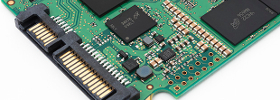

The header image for this article is the innards of Crucial’s MX100 solid state drive, one of the first ever to feature Micron’s 16-nanometer flash memory. The MX100 is an oddball play from Crucial, mixing in the controller from the performance-orientated M550 in with the newer silicon to drop the price and keep performance reasonably high. But they are not the only ones gearing up to do so. 2014 will be the first of many full-on product wars in the SSD market and the first time that OCZ isn’t one of the front-line players (reliability issues aside).
With SSD’s now being cheaper than ever and 256GB drives available for much more reasonable prices, things are only going to escalate from here.
2014 is an interesting year because we have very few companies left making controllers and fewer places to buy NAND from these days. Seagate has bought out Sandforce from LSI, Toshiba has control of OCZ, ADATA is buying older SSD designs from Crucial, Western Digital doesn’t have their drive out yet, Intel is moving into performance storage with the M.2 and PCI-Express markets and Marvell is laughing all the way to the bank because almost everyone is using their controllers.
Some companies have even retreated into safer markets. Corsair hasn’t been in the speed race for a while after the Neutron and Neutron GTX families, but the Force LX now uses the Silicon Motion controller and Toshiba memory, giving it some legs against the onslaught of cheap Crucial drives. Samsung hasn’t released anything drastically different in the last year and the time is right for something like an 850 Pro to appear and make their rivals take cover while the bombs drop.
But while most companies are breaking into the low-price barrier, one of them hasn’t made their mark just yet. Before they went down, OCZ’s drives were among the fastest in the land and the Barefoot 3 controller was very good, but they were seeing reliability issues and damage from overvolting some components.
Under Toshiba, though, things change considerably – Toshiba now controls the firmware, the controller and the flash memory inside their SSDs – the three main components that decide the final performance of the drive. This means that they will be able to go toe-to-toe with Samsung pretty soon as well as out-price anyone using a Marvell controller and Micron memory.
Jostling for a good vantage point
Digitimes reported last week Thursday, 19 June, that Micron, Intel, Kingston, SanDisk and Samsung were all gearing up for a price war. With the price of flash memory dropping faster than the faces of Batman fans upon hearing the news of “Batffleck”, there seems to be some jostling between the vendors as to who gets to be in the starting gates.
Micron in particular is dropping the amount of orders for flash memory available to partners, choosing to rather use the available capacity in their factories to ramp up shipments of their SSDs. Samsung and SanDisk are currently vying for the top spot in the US rankings and Crucial needs to get in there.
Intel meanwhile is focusing their efforts almost entirely on the M.2 and PCI-Express markets. The company has a new controller on the block, the completely custom NVMe, which is currently being used in all of their datacenter products and will eventually climb down to the enthusiast markets over time. Just one 400GB SSD PC3500 has the sustained 4K write speed of six regular drives in RAID 1.
To top it off, nearly every manufacturer has something designed for the M.2 and SATA Express markets. It’ll be a while before we see a real winner, but PCI-Express is leaps and bounds ahead of anything currently being done.
The Battleground: 128GB, 256GB and 512GB
Comparing SSDs- 128GB |
|||||
| Rebeltech | TakeAlot | Raru | Wootware | Landmark PC | |
| ADATA Premier Pro SP600 128GB (JMicron) | R849 | R869 | R877 | ||
| Transcend SSD340 128GB | R951 | R914 | R1002 | R1029 | |
| Crucial MX100 128GB | R993 | R1050 | R1158 | R1111 | |
| Corsair Force LX 128GB | R1027 | R1105 | |||
| Kingston SV300S37A 120GB | R1104 | ||||
| Crucial M500 120GB | R1075 | R1072 | R1027 | ||
| SanDisk Standard 128GB | R1127 | ||||
| Crucial M550 128GB | R1216 | R1348 | R1329 | ||
| ADATA Premier Pro SP600 128GB (Sandforce) | R1213 | R1242 | |||
| ADATA XPG SX900 128GB | R1213 | R1242 | R1286 | R1253 | |
| Seagate 600 128GB | R1217 | R1308 | R1436 | R1422 | R1313 |
| Corsair Force GS 128GB | R1281 | R1285 | R1411 | R1365 | R1378 |
| SanDisk Ultra Plus 128GB | R1290 | ||||
| Samsung 840 Evo 128GB | R1310 | R1324 | R1249 | R1365 | |
| ADATA Premier Pro SP920 128GB | R1334 | R1366 | |||
| Transcend SSD720 128GB | R1356 | R1429 | R1415 | ||
| Corsair Force LS 128GB | R1359 | R1354 | R1486 | R1448 | |
| Kingston HyperX FURY 120GB | R1366 | ||||
In the 128GB space, things are really, really competitive. This is the price point where new systems are typically able to pick up a drive for use as the daily driver. Straight away there are a few things to notice – any SSD that uses Asynchronous memory is going to be really, really cheap and it’s only fit for use in a drive that needs to duck under R1000. The ADATA SP600 and the Transcend SSD340 fulfill that need and they are perfectly serviceable as boot and system drives. However, don’t expect much in the way of proper write leveling or good sustained write speeds.
I won’t go into detail about how every drive is doing at its relative price point, but three stand out here – the Crucial MX100, the M550 and Corsair’s Force LX. All three have brand new controllers, all three have either 16nm (MX100) or 19nm flash memory and they’re all competitively priced. It remains to be seen how well the controller in the LX handles wear leveling but it does use at least half the power of any other custom solution, so it’ll be right at home in a low-power rig or a laptop.
Going up, I have to stop off at the R1500 mark for 128GB drives. Sure, it’ll be really fast compared to these and some 256GB drives, but the fact remains that none of the 128GB drives selling for more than R1500 will be as attractive as a SSD with more storage. That leaves companies like Samsung in the lurch, because the 128GB 840 Pro is blisteringly fast, but difficult to sell now.
Comparing SSDs- 240GB to 256GB |
|||||
| Rebeltech | TakeAlot | Raru | Wootware | Landmark PC | |
| Crucial MX100 256GB | R1430 | R1474 | R1399 | ||
| ADATA Premier Pro SP600 246GB (JMicron) | R1699 | R1739 | R1754 | ||
| Transcend SSD340 256GB | R1725 | R1598 | R1755 | R1799 | |
| Corsair Force LX 256GB | R1756 | R1861 | |||
| Kingston SV300S37A 240GB | R1839 | ||||
| ADATA Premier Pro SP900 256GB |
R1941 | R1987 | R1986 | R2005 | |
| Crucial M550 256GB | R2071 | R2297 | R2265 | ||
| ADATA Premier Pro SP920 256GB | R2184 | R2236 | |||
| Crucial M500 240GB | R2199 | R1615 | R1791 | R1599 | R1668 |
| Corsair Force LS 240GB | R2248 | R2690 | R2582 | ||
| Corsair Force GS 240GB | R2266 | R2213 | R2432 | R2336 | R2359 |
| Kingston HyperX 240GB | R2274 | ||||
| Samsung 840 Evo 250GB | R2281 | R2382 | R2095 | R2381 | |
| ADATA XPG SX900 256GB | R2306 | R2360 | R2358 | ||
| Seagate 600 240GB | R2306 | R2168 | R2382 | R2358 | R2381 |
| Kingston HyperX FURY 240GB | R2360 | ||||
| SanDisk Ultra Plus 256GBGB | R2369 | R2381 | |||
| SanDisk Standard 256GB | R2490 | ||||
| Transcend SSD720 256GB | R2474 | R2608 | R2558 | ||
Many more interesting things are happening in the 240Gb to 256GB space. These drives are big enough for the OS, your apps, a bit of personal files and about 4-5 games, size depending. Right off the bat, Crucial’s MX100 does what it was designed to do – be the cheapest, best-valued 256GB drive on the market and arguably they’ve done far more than that. The MX100 is just as fast, if not faster, than the ADATA Sp920, which is much more expensive. With a system drive as cheap as the MX100 with the solid performance credentials from Crucial, why would any sane person spend over R2000 for the same drive space?
Still, some of the higher-priced drives do have their merits if you crave more performance. The Crucial M550 offers great performance for a decent price if you’re buying it off Takealot and it’s at least as fast as Samsung’s 840 Pro, which is too expensive to be considered here. If you get it for a song, Seagate’s 600 is technically faster and more capable, but it is more expensive on average and the LAMD controller is lacking in high-end performance compared to Marvell controllers with more mature firmware.
The strangest thing is no longer seeing Intel being competitive, but their focus is now on performance and the higher-end markets, where consumers are willing to pay more than the average price for their software and their validation testing. With 256GB drives, the ceiling for it being attractive is around R2500. There’s no reason to spend more than that and if you are, it’s for jumping up to a 512GB drive.
Comparing SSDs- 480GB to 512GB |
|||||
| Rebeltech | TakeAlot | Raru | Wootware | Landmark PC | |
| Crucial MX100 512GB | R2920 | R3099 | R2945 | ||
| Crucial M500 240GB | R3170 | R3517 | R3299 | R3275 | |
| Kingston SV300S37A 480GB | R3694 | R4017 | |||
| ADATA XPG SX900 512GB | R4127 | R4224 | R4185 | ||
| Crucial M550 512GB | R4157 | R4613 | R4506 | ||
| Samsung 840 Evo 500GB | R4224 | R4388 | R4340 | R4308 | |
| Corsair Force GS 480GB | R4314 | R4415 | R4371 | R4374 | |
| Seagate 600 480GB | R4734 | R5115 | R4801 | ||
| Kingston HyperX 480GB | R4855 | ||||
| Samsung 840 Evo 750GB | R5015 | R4920 | R4924 | ||
The market shrinks considerably once you get to the 512GB space and even then, there are only two real contenders here at opposite ends of the table. Crucial’s MX100 is at the top again in terms of price-per-gigabyte, turning in a stupidly cheap ~R5.70 per GB. Ducking in under R3000 in most places, it’s also well-equipped to make performance-orientated 256GB drives quake in their boots because quite often the extra flash memory chips just do the job better than a drive just designed to be fast.
The MX100 is also going to be at least as fast as two 256GB MX100 drives in RAID 0, with the exception of write performance which will end up being much lower. Considering, though, that two 512GB MX100 drives will be faster and cheaper than most 1TB SSDs, it might just be a no-brainer. The really, really weird thing is that the MX100 in 512GB form is almost the exact same drive as the M550, which costs quite a bit more.
Where the story ends for now for anyone buying a SSD is with the 750GB Samsung 840 Evo. I’ll say it again – seven hundred and fifty gigabytes. That’s ~R6.56 per gigabyte. Sure, it won’t be much faster than most 512GB drives, but it does offer way more capacity in the same form factor. And the price only keeps dropping.
Who will emerge victorious in the consumer market?
I have my bets set on Samsung, Seagate, Crucial, Hynix and Toshiba. Samsung and Toshiba will run away in 2015 because they control every aspect of their drives and are able to push the performance envelope more. Crucial will keep on pummeling their opponents with cheaper and cheaper flash memory, playing the value card whilst still winning in the benchmarks when it comes to their more performance-orientated drives like the M550. Maybe they’ll try to buy Marvell at some point.
Hynix will come out of nowhere in 2015. They make memory for so many other companies already and they own LAMD in its entirety (as of 2012). They could easily make super-fast flash memory along with a newer version of the controller found in Seagate’s 600 and Corsair’s Neutron GTX drives and make a beatstick that’s just as strong as Samsung’s efforts.
Seagate is in an interesting position because they have no flash memory fabrication plants, but they now own LSI. They could morph Sandforce into anything they wanted and they are well within their rights to keep the controller in-house once contracts with LSI’s older partners runs out.
Either way, the best time to buy a SSD is now. Today. Don’t delay!